
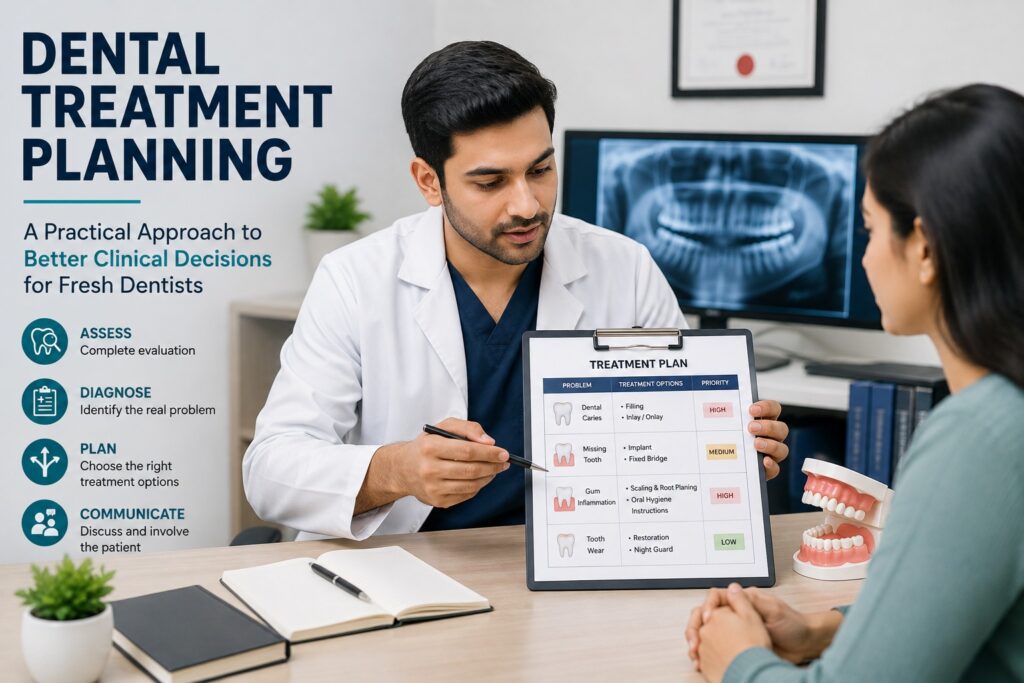
Completing BDS gives dentists a strong foundation in diagnosis and clinical procedures. However, moving from college training to independent clinical practice requires more than knowing how to perform individual procedures.
One of the most important skills is dental treatment planning.
A patient may visit with pain, sensitivity, a broken tooth, difficulty chewing, or an aesthetic concern. The visible problem may not always be the only problem that needs attention. A dentist must understand the patient’s overall oral condition, establish a diagnosis, identify priorities, consider suitable treatment options, and decide when guidance or referral is appropriate.
Why Is Treatment Planning More Than Choosing a Procedure?
Dental treatment planning is the process of deciding what treatment a patient needs, why it is needed, and how the treatment should be carried out in an appropriate sequence.
It is not simply choosing between a filling, root canal treatment, extraction, or crown.
A good plan connects:
- The patient’s main complaint
- Clinical findings
- Diagnosis
- Overall oral health
- Available treatment options
- Patient expectations
- Long-term functional and oral health needs
- The dentist’s current clinical capabilities
Start With the Patient, Not the Procedure
Before thinking about a particular procedure, understand why the patient has come to the clinic.
Ask about the main concern, symptoms, duration, previous treatment, expectations, and any other problems the patient has noticed.
This helps prevent a common mistake among fresh dentists: deciding on a procedure before fully understanding the patient’s problem.
Look at the Complete Clinical Picture
A patient complaining of tooth pain may also have untreated caries, periodontal problems, missing teeth, defective restorations, or other conditions.
Treatment planning in dentistry should therefore look beyond the most obvious complaint.
The goal is to understand the patient’s overall clinical situation rather than treating one isolated finding without considering the rest of the mouth.
Consider the Available Treatment Possibilities
Once the diagnosis is established, the dentist should consider appropriate treatment options and their limitations.
Different patients may have different priorities, expectations, financial considerations, or maintenance requirements. The most suitable treatment is not determined by the procedure alone; it should also fit the patient’s clinical situation and needs.
Think Beyond the Immediate Procedure
A treatment plan should also consider what happens after the immediate problem is addressed.
Factors such as remaining tooth structure, periodontal health, oral hygiene, function, maintenance, and future restorative requirements can influence the treatment sequence.
This broader approach helps fresh dentists develop better long-term clinical judgment.
What Should a Dentist Assess Before Creating a Treatment Plan?
A structured assessment makes dental treatment planning more reliable.
Before finalizing a plan, consider:
1. Patient history and chief complaint
Understand the patient’s symptoms, concerns, expectations, and relevant history.
2. Clinical examination
Examine the teeth, supporting tissues, occlusion, oral hygiene, and other relevant clinical findings.
3. Diagnostic information
Use appropriate diagnostic investigations when required to support or confirm the clinical assessment.
4. Patient priorities
Understand what the patient considers most important, whether that is pain relief, function, appearance, or another concern.
5. Overall treatment needs
Look at the complete oral condition rather than focusing only on the tooth that brought the patient to the clinic.
A useful sequence is:
History → Examination → Diagnosis → Treatment options → Priorities → Treatment sequence
This provides a clearer foundation for clinical decision-making.
How Should Fresh Dentists Prioritize Multiple Dental Problems?
Address Urgent Problems First
Pain, acute infection, swelling, trauma, or other urgent conditions may require immediate attention.
The first priority is to manage the immediate clinical problem appropriately before moving to elective or longer-term treatment.
Control Active Disease
Where appropriate, active disease should be controlled before proceeding with more complex or definitive treatment.
For example, oral hygiene, periodontal health, caries control, and other relevant factors may influence the success of subsequent treatment.
Consider Treatment Sequence
Some procedures affect what can be done later. Therefore, treatment should be organized in a logical sequence rather than performed simply according to which problem appears easiest.
Discuss Functional and Aesthetic Priorities
Patients may have specific concerns about appearance, chewing, comfort, or timing.
Understanding these priorities helps the dentist develop a plan that is clinically appropriate while also addressing what matters to the patient.
How Should Dentists Explain Treatment Options to Patients?
A technically correct treatment plan is not enough if the patient does not understand it.
Fresh dentists should explain treatment options using simple, patient-friendly language.
Where appropriate, explain:
- What the problem is
- Why treatment may be required
- The relevant treatment options
- Benefits and limitations
- What may happen if treatment is delayed
- Expected appointments or treatment stages
- Maintenance requirements
The conversation should also allow the patient to ask questions.
Good communication helps patients understand their choices and supports shared decision-making.
When Should a Treatment Plan Be Reconsidered?
A treatment plan is not always fixed from the beginning of treatment.
It may need to be reconsidered when:
- New clinical findings appear
- Additional diagnostic information changes the assessment
- The patient’s priorities change
- The expected clinical response does not occur
- The complexity of the case becomes clearer
- The original treatment approach is no longer appropriate
Fresh dentists should develop the habit of reassessing the case when necessary, rather than continuing with an original plan simply because it was already decided.
Common Treatment-Planning Mistakes Fresh Dentists Should Avoid
Several mistakes can make clinical decision-making more difficult.
Planning Before Confirming the Diagnosis
A procedure should not be selected simply because a tooth looks damaged or the patient reports pain.
The diagnosis should guide the treatment plan.
Focusing Only on the Obvious Problem
Treating the chief complaint without assessing the rest of the oral condition can result in an incomplete treatment plan.
Ignoring Treatment Sequence
Even appropriate procedures can become difficult when they are performed in the wrong order.
Overestimating Clinical Readiness
Fresh dentists may know the theory behind a procedure but still lack sufficient practical experience to manage every clinical situation independently.
Recognizing personal limits is part of professional clinical judgment.
Failing to Reassess
Clinical conditions can change. If new information appears, the treatment plan should be reviewed rather than followed automatically.
How Can Fresh Dentists Improve Their Treatment Planning Skills?
Treatment planning improves with clinical exposure, case discussions, feedback, and structured practical learning.
Reading textbooks can provide knowledge, but real cases require dentists to connect multiple decisions:
What is the problem? → What is the diagnosis? → What does the patient need? → What are the treatment options? → What should be done first? → Can I manage this case safely?
Case-based learning is particularly useful because it allows fresh dentists to practice thinking through complete cases rather than focusing only on individual procedures.
Supervised clinical exposure can further help dentists understand how treatment planning connects with actual patient management.
What Should Fresh Dentists Look for in Treatment-Planning Training?
When choosing dental treatment planning for fresh dentists, look for training that goes beyond demonstrations of individual procedures.
Useful training should include:
- Case-based treatment planning
- Discussion of clinical findings
- Diagnosis and treatment sequencing
- Practical decision-making
- Supervised clinical guidance
- Exposure to different levels of case complexity
- Feedback on treatment decisions
The goal should not simply be to learn more procedures. It should be to understand when, why, and how a procedure should be used.
At Kaamat Dental Academy, practical dental education can help fresh dentists connect their BDS knowledge with real-world clinical thinking through structured learning and hands-on exposure.
Frequently Asked Questions
What is dental treatment planning?
Dental treatment planning is the structured process of assessing a patient’s clinical condition, establishing a diagnosis, considering appropriate treatment options, prioritizing needs, and deciding the sequence of treatment.
Why is treatment planning important for fresh dentists?
It helps fresh dentists make more structured clinical decisions instead of choosing procedures based only on symptoms or obvious findings.
What should a dentist consider before treatment?
A dentist should consider the patient’s history, clinical findings, diagnosis, appropriate diagnostic information, treatment options, patient expectations, overall oral health, treatment sequence, and the dentist’s ability to manage the case safely.
Can a treatment plan change after treatment begins?
Yes. New findings, changes in the patient’s condition, additional diagnostic information, or changes in patient priorities may require the treatment plan to be reassessed.
How can fresh dentists improve treatment planning skills?
Fresh dentists can improve through case-based learning, clinical discussions, supervised practice, feedback, and regular exposure to different types of cases.
Final Takeaway
Good dental treatment planning starts before the procedure.
For fresh dentists, the key is to develop the habit of looking at the complete clinical situation rather than immediately deciding which procedure to perform.
A structured approach history, examination, diagnosis, treatment options, prioritization, communication, and reassessment can improve clinical decision-making and patient care.
Most importantly, fresh dentists should understand their current level of competence and seek appropriate guidance when a case is beyond their experience.
With consistent clinical exposure and practical training, treatment planning can become a stronger and more confident part of everyday dental practice.
