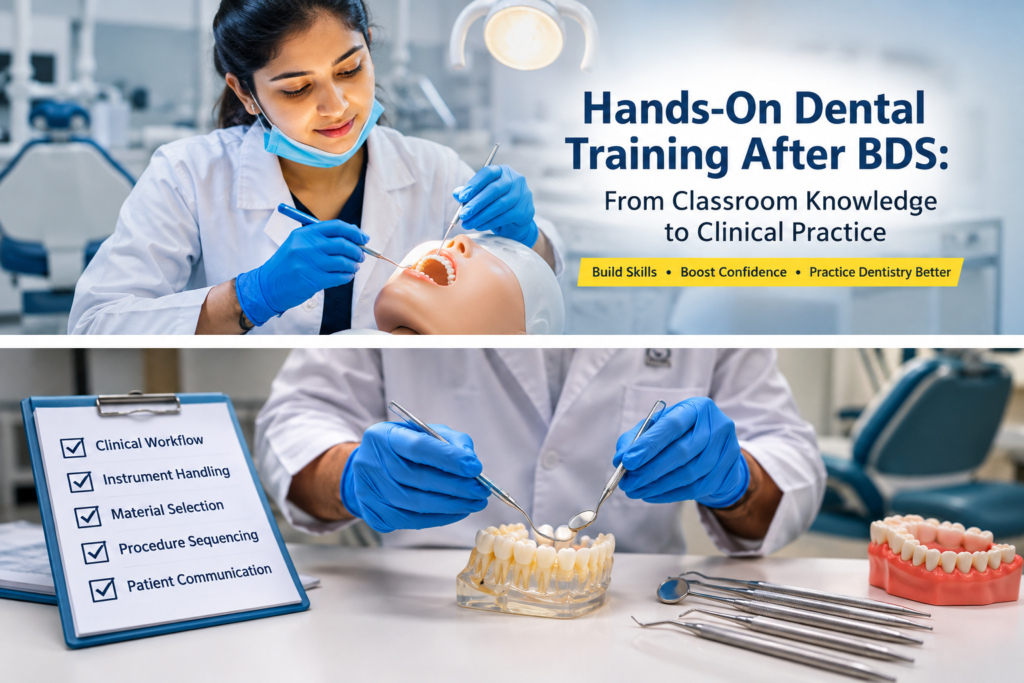
Why Clinical Training Feels Different From Dental School
Completing BDS gives a graduate a structured understanding of dentistry. Students spend years studying dental sciences, observing procedures, assisting in clinics, and gaining exposure to different areas of patient care.
But clinical dentistry has another layer that cannot always be understood completely through textbooks or lectures.
A real clinical setting involves multiple things happening at the same time. A dentist has to assess the patient, understand the clinical findings, prepare the required instruments and materials, follow the correct sequence of treatment, communicate with the patient, and respond appropriately when something does not go exactly as expected.
This is why hands-on dental training after BDS can be valuable.
It gives graduates an opportunity to focus specifically on the practical side of dentistry and understand how individual clinical steps fit together.
The purpose is not to repeat BDS education.
Instead, the focus is on turning existing theoretical knowledge into more structured practical understanding.
What Happens Inside a Real Dental Clinical Workflow?
A dental procedure rarely begins when the first instrument is picked up.
There is usually a sequence of decisions and preparations that happen before treatment starts.
A typical clinical workflow may involve:
Patient assessment → Clinical examination → Diagnosis → Treatment planning → Preparation → Procedure → Restoration → Post-treatment instructions
Each stage has its own purpose.Clickhere
For example, before beginning a procedure, the dentist needs to determine what treatment is appropriate, what instruments and materials may be required, whether additional diagnostic information is needed, and how the patient should be positioned.
Understanding this workflow helps a graduate see dentistry as a complete clinical process rather than a collection of individual procedures.
Hands-on learning can make these connections easier to understand because the learner gets to observe how preparation, execution, and finishing stages work together.
The Practical Skills That Require More Than Textbook Learning
Some aspects of dentistry become clearer only when they are demonstrated and practiced.
These can include:
- Proper instrument handling
- Chairside positioning
- Maintaining an organized working field
- Understanding procedural sequences
- Handling dental materials correctly
- Maintaining appropriate isolation
- Working with clinical equipment
- Coordinating hand movements
- Managing the sequence of multiple treatment steps
The objective is not simply to perform a procedure quickly.
Good practical learning focuses on accuracy, consistency, understanding, and appropriate technique.
A graduate should understand not only what to do, but also why a particular step is performed and what can happen if the sequence is not followed appropriately.
Learning to Handle Instruments, Materials, and Equipment
Dental instruments can look simple when viewed individually, but using them effectively requires familiarity.
Different instruments are designed for specific purposes, and their handling can influence the efficiency and control of a procedure.
The same applies to dental materials.
A graduate may know the theoretical properties of a material but still need practical exposure to understand:
- How it is prepared
- How it is handled
- How much is required
- How working time affects the procedure
- How it should be placed
- What precautions are necessary
Similarly, modern dental equipment should be understood in terms of clinical application, not simply its features.
Practical training can help connect the equipment seen in a dental clinic with the specific situations in which it may be useful.
Understanding the Sequence Behind a Dental Procedure
A dental procedure is not just a series of technical steps. The order in which those steps are performed can affect how efficiently and predictably the treatment progresses.
For a dental graduate, understanding this sequence is an important part of practical learning.
Before starting a procedure, the clinician needs to consider:
- What is the patient’s main concern?
- What clinical findings are present?
- What treatment is appropriate?
- What instruments and materials will be required?
- What should be prepared before the procedure begins?
- What needs to be checked during treatment?
- What should happen after the procedure?
This way of thinking helps develop a more organized approach to clinical work.
From Procedure Steps to Clinical Thinking
Instead of memorizing:
Step 1 → Step 2 → Step 3 → Step 4
practical learning should encourage the graduate to understand:
Finding → Decision → Action → Evaluation
For example, if a clinical finding changes during treatment, the dentist may need to reassess the situation rather than continue mechanically with the original sequence.
That ability to observe, interpret, and respond is an important part of clinical practice.
Why Case Assessment Matters Before Starting Treatment
Two patients may appear to need the same type of procedure but still require different clinical approaches.
Differences in tooth condition, existing restorations, oral health, anatomy, previous treatment, and patient-specific factors can influence treatment planning.
This is why hands-on learning should not focus only on how to perform a procedure.
It should also teach learners to think about when a procedure is appropriate and what needs to be considered before beginning it.
A practical training environment can help graduates become familiar with questions such as:
- What information should be collected before treatment?
- Which findings are clinically relevant?
- What additional assessment may be required?
- What materials and instruments should be prepared?
- Are there factors that could make the procedure more difficult?
- What should be explained to the patient beforehand?
This type of preparation can make clinical learning more structured and purposeful.
How Supervised Practice Can Improve Procedural Learning
Watching a procedure and performing a procedure are two different learning experiences.
Observation helps a learner understand what happens.
Supervised practice helps the learner understand how those steps are carried out.
Under appropriate guidance, practical training can provide an opportunity to:
- Observe the correct technique.
- Understand why each step is performed.
- Practice the technique in a controlled setting.
- Receive feedback.
- Identify areas that need improvement.
- Repeat the technique with better understanding.
The feedback component is particularly valuable.
A learner may not notice an inefficient hand position, incorrect instrument handling, or an unnecessary step until someone with appropriate clinical experience points it out.
That is one reason structured hands-on learning can be more useful than trying to learn complex clinical techniques entirely through self-practice.
Common Practical Gaps Fresh Dental Graduates May Experience
Every graduate has a different level of clinical exposure. Some may feel comfortable with certain procedures, while others may want additional practice in particular areas.
Common areas where graduates may want to strengthen their practical understanding include:
Instrument Familiarity
Knowing the names of instruments is different from being comfortable selecting and handling them during a procedure.
Treatment Sequencing
A graduate may know individual steps but still need more experience understanding how those steps connect into a complete workflow.
Material Handling
Dental materials often have specific handling requirements. Practical exposure can help learners become more familiar with their working characteristics.
Chairside Organization
Preparing instruments, materials, and the working area in advance can make a procedure more organized.
Clinical Decision-Making
Real cases may not always follow textbook examples. Learning how to assess findings and decide on the next appropriate step is an important part of clinical development.
These are not signs that a graduate lacks dental knowledge. They are areas that can naturally develop through continued clinical exposure and structured learning.
How to Choose a Hands-On Dental Training Program
Not every clinical training program offers the same type of practical learning. Before enrolling, a BDS graduate should look beyond the course title and understand what the training actually provides.
A useful program should have a clear connection between what is taught and what learners are expected to understand or practice.
1. Look at the Practical Component
The first question should be simple:
How much of the program is actually hands-on?
A course that mainly consists of lectures may provide useful theoretical information, but it may not offer the same practical learning experience as a program designed around clinical skill development.
Check whether the program includes opportunities for:
- Practical demonstrations
- Instrument familiarization
- Procedural practice
- Case-based learning
- Guided clinical exercises
- Feedback from experienced professionals
2. Understand Who Provides the Training
The quality of practical learning is closely connected to the people providing the training.
Before joining a program, look at the faculty or clinicians involved and understand their clinical experience, areas of expertise, and teaching approach.
Practical training becomes more valuable when learners can ask questions, understand the reasoning behind clinical steps, and receive appropriate guidance during learning.
3. Check Whether the Program Covers Real Clinical Workflows
A good training program should go beyond demonstrating isolated procedures.
It should help learners understand how clinical work is organized from beginning to end.
For example:
Assessment → Planning → Preparation → Procedure → Evaluation → Restoration or Follow-up
This broader approach can help graduates understand how individual skills fit into everyday dental practice.
What Should You Look for in a Hands-On Dental Training Program?
Before choosing a program, consider these questions:
Is the training structured?
There should be a clear learning progression rather than unrelated procedures being demonstrated one after another.
Is practical exposure included?
Understand exactly what practical activities are part of the program.
Is guidance available?
Learners should know who will guide them during practical sessions and how feedback is provided.
Are modern clinical methods discussed?
The program should help learners understand current approaches and technologies relevant to the subject being taught.
Is the program suitable for your current level?
A fresh BDS graduate and an experienced clinician may have very different learning requirements.
Choosing a program that matches your existing knowledge can make the learning experience more useful.
How to Make the Most of Clinical Training
Joining a hands-on program is only the beginning. The way you approach the training can significantly influence what you gain from it.
Prepare Before Each Session
Review the basic theory related to the procedure before attending a practical session.
You don’t need to memorize every detail.
Instead, understand:
- The purpose of the procedure
- Basic indications
- Important precautions
- Instruments involved
- General treatment sequence
This allows you to focus more effectively on the practical aspects during training.
Ask “Why?” Not Just “How?”
One of the most useful habits during clinical learning is asking why a particular step is performed.
Instead of only asking:
“How do I perform this step?”
also ask:
“Why is this step necessary?”
Understanding the reasoning behind a technique makes it easier to apply the knowledge appropriately in different clinical situations.
Learn From Feedback
Practical training becomes more valuable when feedback is treated as part of the learning process.
A correction is not necessarily a sign that something went wrong.
It is an opportunity to identify a specific area that can be improved.
Keep track of the techniques you find difficult and revisit them during future learning sessions.
Don’t Focus Only on Speed
A common mistake during practical learning is trying to complete a procedure as quickly as possible.
Speed should not be the primary objective when learning a new clinical technique.
Initially, focus on:
Understanding → Accuracy → Technique → Consistency
Efficiency can develop with appropriate experience.
Build a Habit of Clinical Documentation
Clinical learning also involves understanding how treatment information is documented.
Depending on the setting and procedure, this may include:
- Patient history
- Clinical findings
- Diagnosis
- Treatment plan
- Procedure details
- Materials used
- Post-treatment instructions
- Follow-up information
Good documentation is part of organized clinical practice and should not be overlooked during practical training.
Who Can Benefit From Hands-On Dental Training?
Hands-on dental training can be useful for different stages of a dental professional’s learning journey. The learning goals may differ depending on previous clinical exposure, areas of interest, and the type of procedures the learner wants to understand better.
Fresh BDS Graduates
Graduates who have recently completed BDS may want additional exposure to practical workflows before taking on greater clinical responsibilities.
Structured training can help them revisit important clinical concepts while focusing more closely on the practical side of dentistry.
Dentists Developing a Specific Clinical Skill
A dentist may already have clinical experience but want to strengthen a particular area of practice.
In such cases, focused hands-on training can provide an opportunity to learn a specific technique, understand newer approaches, and refine practical execution.
Dentists Returning to Clinical Practice
Professionals who have had a break from regular clinical practice may also benefit from structured practical learning.
How Kaamat Dental Academy Fits Into Clinical Skill Development
For dental graduates looking to strengthen their practical understanding, Kaamat Dental Academy focuses on clinical skill development through structured learning and hands-on exposure.
The objective of this type of training is not simply to demonstrate procedures.
It is to help learners understand the connection between clinical knowledge, treatment planning, procedural steps, instruments, materials, and practical application.
For a graduate, this can provide a more focused learning environment to develop skills beyond what can be achieved through theoretical study alone.
The right training program should always be selected according to the learner’s existing experience, learning objectives, and the specific clinical skills they want to develop.
How to Continue Learning After a Hands-On Program
Clinical development does not end when a training program finishes.
Dentistry continues to evolve, and clinicians can keep developing their skills through:
- Regular clinical practice
- Case discussions
- Continuing education
- Reviewing current clinical guidelines
- Learning from experienced professionals
- Attending focused workshops
- Reflecting on completed cases
- Keeping up with relevant developments in dental technology
The most useful approach is to treat hands-on training as one stage in continuous professional development, rather than as a replacement for ongoing clinical learning.
FAQ’s
Is hands-on dental training necessary after BDS?
It is not a universal requirement for every graduate, but additional practical training can be useful for dentists who want to strengthen particular clinical skills or gain more structured practical exposure.
What is the difference between BDS education and hands-on dental training?
BDS provides broad academic and clinical education as part of a formal dental degree. Hands-on training is generally more focused on developing or refining specific practical skills and clinical techniques.
Can a fresh BDS graduate join hands-on dental training?
This depends on the individual program. Graduates should check the eligibility requirements, curriculum, practical components, and level of clinical exposure before enrolling.
Does hands-on training guarantee clinical success?
No. Training can support learning and skill development, but clinical competence develops through appropriate education, supervised learning, experience, continued practice, and professional judgment.
How should I choose a dental clinical training program?
Look at the curriculum, practical exposure, faculty experience, training format, eligibility requirements, learning objectives, and whether the program matches your current level and goals.
Is practical training only useful for fresh graduates?
No. Experienced dentists may also use focused training to learn new techniques, refresh existing skills, or develop expertise in a particular area.
Final Thoughts
A dental degree provides a strong foundation, but clinical learning continues throughout a dentist’s professional journey.
Hands-on dental training can provide a focused environment for understanding how clinical knowledge is applied through instruments, materials, treatment workflows, and practical techniques.
The most valuable training is not necessarily the program with the longest list of procedures or the most equipment.
Instead, look for learning that provides clear instruction, structured practical exposure, appropriate guidance, and opportunities to understand the reasoning behind clinical techniques.
For BDS graduates and practicing dentists, choosing the right form of additional training can be an important step in continuing professional development.
Take the Next Step
If you are a dental graduate looking to strengthen your practical clinical skills, explore the clinical skill development programs available at Kaamat Dental Academy and choose a learning pathway that matches your current experience and professional goals.
