
Completing BDS is a major milestone, but for many dental graduates, it also brings an important question:
What should I do after BDS?
Some graduates want to pursue MDS. Others want to start working, improve their clinical skills, or explore a specific area of dentistry. There are also diploma, certificate, fellowship, and short-term clinical training programs available for dentists.
A good course should help you move closer to the kind of dentist you want to become—not simply give you another certificate.
What Should You Do After BDS?
There is no single answer that works for every BDS graduate.
Your next step should depend on where you see yourself in the next few years.
For example, if you are interested in becoming a specialist and are prepared for postgraduate study, MDS may be the appropriate path. If you want to start working and gain practical experience, joining a dental clinic or hospital may be more suitable.
Another option is to take a focused clinical course after BDS to strengthen specific skills before or alongside clinical practice.
Some graduates also choose non-clinical paths such as public health, healthcare management, research, teaching, or dental-related industries. The important thing is to understand what you actually want before spending significant time and money on a course.
What Types of Courses Can You Consider After BDS?
The term courses after BDS covers several different types of education and training. Each serves a different purpose.
1. MDS
MDS is a postgraduate specialization pathway for dentists who want structured advanced education in a particular dental specialty.
It requires a significant commitment of time and preparation, so it should be considered carefully rather than chosen simply because it is the traditional next step after BDS.
2. Diploma and PG Programs
Diploma and postgraduate programs can provide more focused education in a particular area.
Depending on the institution and program, these may cover areas such as implant dentistry, aesthetic dentistry, clinical research, or other dental and healthcare fields.
Before enrolling, check the exact curriculum, eligibility, duration, recognition, and clinical exposure.
3. Certificate Courses
Certificate courses are generally shorter and more focused.
They can be useful when you already know which skill you want to develop—for example, endodontics, aesthetic procedures, restorative dentistry, or another specific area.
However, the value of a certificate course depends heavily on what you actually learn and practice, not simply on the certificate itself.
4. Fellowship and Clinical Training Programs
Some dentists prefer structured clinical training that provides deeper exposure to a particular area of dentistry.
These programs may include demonstrations, supervised practice, case discussions, and patient-based learning, depending on the institution.
For fresh graduates who feel that their theoretical knowledge is stronger than their clinical confidence, this type of training can be particularly relevant.
5. Non-Clinical Courses
Not every BDS graduate wants to spend their career entirely in clinical practice.
Depending on your interests, you can explore areas such as public health, healthcare administration, research, medical or dental writing, academics, and other healthcare-related careers.
The right choice is the one that supports your long-term career direction.
How Do You Choose the Right Course After BDS?
Instead of asking “Which is the best dental course?”, ask:
“Which course is best for my current career goal?”
That small change can make your decision much easier.
1. Start With Your Career Goal
First, decide what you want the course to help you achieve.
Do you want to:
- Improve your general clinical skills?
- Become more confident with everyday dental procedures?
- Develop skills in a specific specialty?
- Prepare for private practice?
- Gain additional clinical exposure?
- Explore a specialty before committing to advanced education?
Your answer should influence the type of course you choose.
For example, someone who wants to improve overall clinical confidence may benefit more from broad hands-on general dentistry training than from a highly specialized course.
2. Identify Your Clinical Skill Gap
Be honest about what you can and cannot do confidently.
You may understand a procedure theoretically but still struggle when faced with an actual patient.
That is not unusual after BDS.
A course becomes much more valuable when it directly addresses your skill gap.
3. Look at the Hands-On Exposure
For a dentist looking to improve clinical skills, hands-on exposure can make a significant difference.
A course that only provides lectures may not be enough if your main objective is to become more comfortable with clinical procedures.
Look for programs that clearly explain:
- What practical training is included
- Whether demonstrations are provided
- Whether simulation or patient-based practice is available
- How much supervised practice participants receive
- Whether case discussions are part of the curriculum
Some clinical training programs specifically combine lectures, demonstrations, simulation, and patient-based learning.
4. Check the Faculty and Supervision
Who teaches you matters.
Look at the clinical and academic background of the faculty members. More importantly, understand how much interaction you will actually have with them during training.
For practical dentistry, simply watching an experienced dentist perform a procedure is different from performing it yourself under appropriate supervision.
5. Consider Patient and Case Exposure
Clinical dentistry is not only about performing procedures.
You also need to learn how to assess patients, understand case complexity, plan treatment, communicate options, and recognize when a case requires additional expertise.
If a course includes genuine clinical exposure, find out what types of cases participants are likely to encounter and what level of supervision is provided.
6. Consider Course Duration
A longer course is not automatically better.
Likewise, a short course is not automatically less valuable.
The right duration depends on your objective.
If you need an introduction to a specific procedure, a short focused program may be enough. If you need broader clinical development and repeated practice, you may need a more structured program with greater clinical exposure.
7. Check Certification and Recognition Carefully
Before joining a dental course, understand exactly what certification you will receive.
Do not assume that every certificate represents a formal postgraduate qualification.
Check:
- Who issues the certificate
- What the certificate represents
- Course eligibility
- Curriculum
- Duration
- Faculty
- Clinical exposure
- Whether any specific accreditation or recognition is claimed
This helps you make a decision based on facts rather than marketing claims.
Should Fresh Dentists Choose Theory-Based or Hands-On Training?
It depends on what you need.
If your primary problem is a lack of theoretical understanding, additional academic learning may be useful.
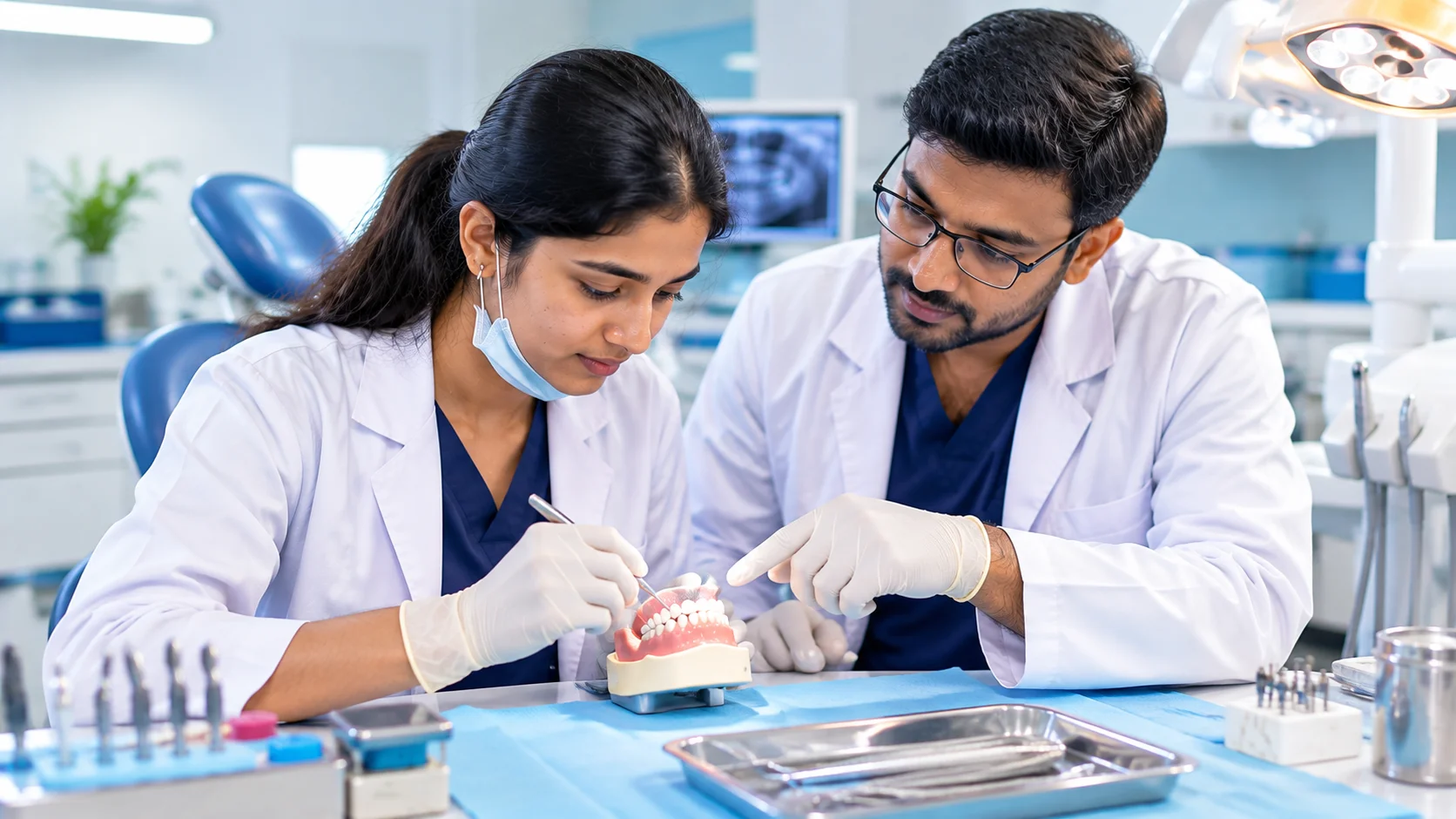
But if you already understand the basic concepts and your main difficulty is “I know the procedure, but I am not confident doing it independently,” practical training may be more relevant.
Hands-on training can help connect theoretical knowledge with actual clinical situations. This is one reason practical dental training programs are often considered by graduates who want to strengthen their clinical confidence after BDS.
The goal should not be to collect courses. The goal should be to develop usable clinical skills.
What Should You Check Before Joining a Dental Course?
Before paying a course fee, ask a few practical questions.
What exactly will I learn?
Read the curriculum instead of relying only on the course title.
How much practical exposure is included?
Find out whether the course involves demonstrations, simulation, supervised practice, or patient-based training.
Who will teach me?
Research the faculty and their clinical experience.
Will the course match my current skill level?
An advanced course may not be useful if you still need to strengthen basic clinical skills.
What happens after the course?
Check whether there is any structured mentorship, case discussion, or additional academic support.
Common Mistakes Dentists Make When Choosing a Course
One common mistake is choosing a course because everyone else is doing it.
Another is choosing based only on the certificate.
Some graduates also select a highly specialized course before developing confidence in basic clinical dentistry.
Other mistakes include:
- Not checking the curriculum
- Ignoring practical exposure
- Choosing based only on price
- Not researching faculty
- Expecting one short course to solve every clinical problem
- Confusing a certificate with a formal postgraduate qualification
- Choosing a course without considering long-term career goals
A better approach is to compare your goal → your skill gap → course curriculum → practical exposure → faculty → time and cost.
When Is a Short-Term Clinical Course More Useful?
A short-term clinical course can be useful when you have a specific learning objective.
For example, you may already be working in a clinic but want to improve a particular procedure. Or you may be a fresh graduate who wants additional practical exposure before taking greater responsibility in clinical practice.
The key is to choose a course that provides enough depth and practice for the skill you are trying to develop.
Short-term does not have to mean superficial—but the course should have a clear learning objective and realistic expectations.
How Can Practical Dental Training Support Early Clinical Practice?
The transition from BDS to independent clinical practice can feel very different from university-based learning.
In college, you learn concepts, procedures, and clinical fundamentals. In practice, you also have to make decisions.
You need to understand:
- Which cases you can manage
- Which cases require guidance
- How to assess treatment options
- How to communicate with patients
- How to plan treatment
- How to manage unexpected clinical situations
Programs such as general dentistry skill development can be particularly relevant when the objective is to strengthen multiple everyday clinical skills rather than focus on just one procedure.
At Kaamat Dental Academy, the focus on practical dental skill development is designed around the needs of dentists who want to strengthen their clinical abilities through structured training and practical exposure.
Frequently Asked Questions
What courses can I do after BDS?
After BDS, you can consider MDS, diploma or postgraduate programs, certificate courses, fellowship programs, clinical training, and non-clinical healthcare-related courses. The right choice depends on your career goals and interests.
Which dental course is best after BDS?
There is no single best course for every dentist. A good course should match your career goal, current clinical skills, learning needs, practical exposure requirements, and available time.
How do I choose a dental course after BDS?
Start by identifying your career goal and clinical skill gaps. Then compare the curriculum, hands-on exposure, faculty, patient or case exposure, duration, certification, and overall cost.
Are hands-on dental courses useful for BDS graduates?
They can be useful when a graduate needs additional practical exposure and supervised experience. However, the value depends on the quality and structure of the training.
Should a fresh dentist choose a clinical or theoretical course?
If your main challenge is applying existing knowledge in real clinical situations, a practical or hands-on program may be more relevant. If you need deeper academic knowledge, a theory-focused program may be more appropriate.
Final Takeaway
Choosing a course after BDS should not be about collecting another certificate.
It should be about answering one simple question:
“What skill or knowledge do I need to develop for the career I want?”
Once you know the answer, compare courses based on their curriculum, faculty, practical exposure, supervision, duration, certification, and overall relevance to your goals.
The right dental course is not necessarily the longest, most expensive, or most heavily promoted one.
It is the one that genuinely helps you move from where you are today to where you want to be as a dentist.
