
Introduction
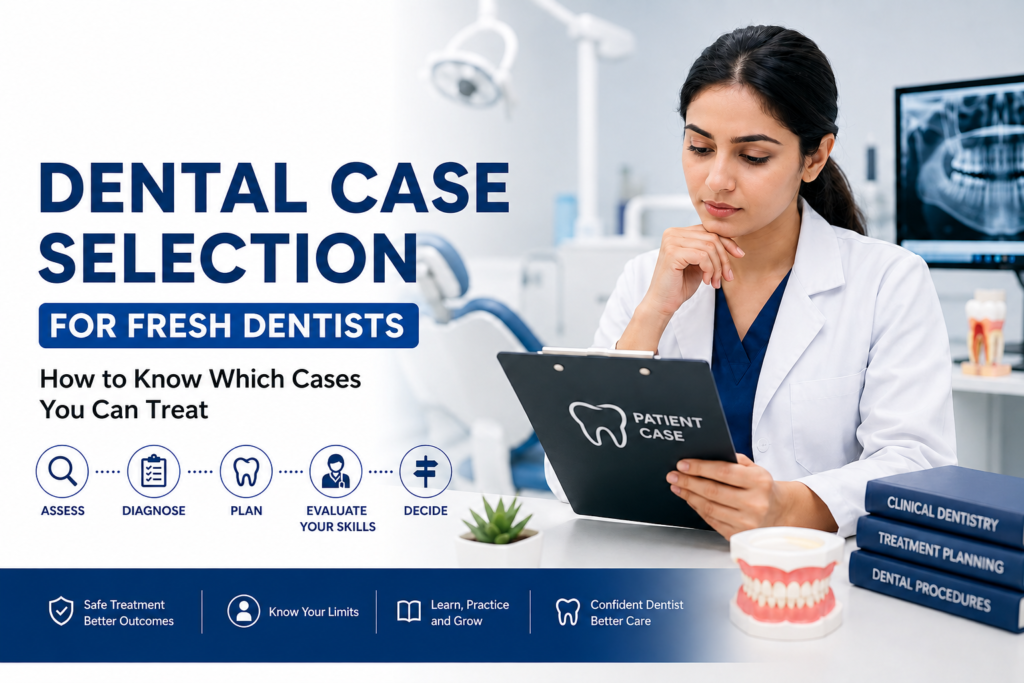
dental case selection for fresh dentists Starting clinical practice after BDS can feel very different from treating patients during college. A fresh dentist may have the basic theoretical knowledge and clinical exposure, but one question often creates uncertainty:
“Can I safely manage this case myself, or should I seek help?”
This is where dental case selection becomes an important clinical skill.
Good case selection is not about avoiding difficult patients or choosing only simple procedures. It is about understanding the patient’s condition, identifying the complexity of the case, assessing your own clinical skills, and deciding whether the treatment can be managed safely within your current level of experience.
For fresh dentists, developing this judgment early can improve confidence and help prevent unnecessary complications. It also creates a better foundation for gradually taking on more complex clinical cases.
In this guide, we will look at how fresh dentists can assess cases before treatment, recognize situations that may require referral or supervision, and develop better clinical decision-making skills through practical exposure.
The First Question Every Fresh Dentist Should Ask Before Treatment
Before starting any procedure, a dentist should pause and assess the case as a whole, rather than immediately focusing on the treatment the patient is requesting.
For example, a patient may come asking for a filling, extraction, or replacement of a missing tooth. But the requested procedure is only one part of the clinical picture.
A better approach is to ask:
“Do I understand the diagnosis, the treatment requirements, and the potential challenges well enough to manage this case?”
This simple question encourages a more structured assessment.
A fresh dentist should consider:
- Is the diagnosis clear?
- Is the treatment indication appropriate?
- Does the case involve any unusual anatomy or complications?
- Do I have the clinical skills required for the procedure?
- Do I have the necessary equipment and support?
- What could make the procedure more difficult than expected?
If these questions cannot be answered confidently, the next step should be further assessment, supervision, or referral, depending on the situation.
The goal is not to build confidence by accepting every case. It is to build confidence through appropriate case selection and controlled clinical experience.
5 Things to Assess Before Accepting a Dental Case
Before accepting a case, a fresh dentist should look beyond the immediate complaint and assess whether the treatment is diagnostically clear, clinically manageable, and within their current level of experience.
1. Understand the Patient’s Main Concern
Start by listening carefully to why the patient has come for treatment. Pain, sensitivity, swelling, difficulty chewing, an aesthetic concern, or a broken tooth can each point toward different clinical considerations.
The patient’s expectation should also be understood before discussing treatment. A clear conversation at the beginning can prevent misunderstandings later.
2. Confirm the Diagnosis
Treatment should follow diagnosis, not the other way around.
A dentist should review the patient’s history, perform an appropriate clinical examination, and use diagnostic aids when required. If the diagnosis is uncertain, it is better to investigate further rather than proceed based only on the patient’s complaint.
3. Assess the Complexity of the Case
Two patients may appear to need the same procedure but have very different levels of difficulty.
Factors such as limited tooth structure, unusual anatomy, multiple affected teeth, deep lesions, restricted access, previous treatment, or associated periodontal concerns can increase complexity.
Recognizing these factors before treatment helps a fresh dentist decide whether the case is suitable for their current skill level.
4. Check Your Clinical Readiness
A fresh dentist should honestly assess whether they have enough experience with the required procedure.
This does not mean avoiding procedures simply because they are unfamiliar. Instead, it means identifying when supervision, additional training, or referral would make treatment safer and more predictable.
Knowing your limits is not a weakness. It is an important part of becoming a responsible clinician.
5. Consider the Available Resources
The clinical environment also matters.
Before accepting a case, consider whether you have the required instruments, diagnostic facilities, materials, infection-control setup, and appropriate clinical support. A case that appears manageable in one setting may become more challenging when essential resources are unavailable.
Good case selection therefore starts before the procedure begins. A few minutes of structured assessment can help a fresh dentist make a more informed treatment decision and prepare appropriately for the case.
Which Cases Are Usually Suitable for Beginners?
For a fresh dentist, starting with appropriate cases is an important part of building clinical confidence. The aim is not to classify cases simply as “easy” or “difficult,” but to understand whether the diagnosis, treatment requirements, and clinical conditions are within the dentist’s current level of competence.
Straightforward Restorative Cases
Cases with a clear diagnosis, adequate tooth structure, accessible treatment areas, and predictable treatment requirements can often provide useful early clinical experience.
These cases allow fresh dentists to focus on developing proper clinical workflow, patient communication, isolation, instrumentation, and finishing techniques without unnecessarily high complexity.
Routine Preventive and Periodontal Care
Basic preventive care and appropriate periodontal procedures can also help fresh dentists develop essential patient-management and clinical examination skills.
These cases provide opportunities to understand oral hygiene concerns, identify periodontal conditions, communicate preventive advice, and establish long-term patient relationships.
Simple Extractions
A straightforward extraction may be suitable when the clinical and radiographic assessment indicates a predictable case and there are no significant complicating factors.
However, a dentist should not judge extraction difficulty only by how visible or mobile the tooth appears. Root morphology, surrounding structures, previous treatment, and other clinical findings can change the level of difficulty.
Basic Prosthodontic Cases
Some uncomplicated prosthodontic cases can provide valuable experience with treatment planning, impressions, patient communication, laboratory coordination, and delivery procedures.
The key is to select cases where the dentist understands the required steps and can manage the expected clinical challenges.
Why Case Selection Should Gradually Progress
Fresh dentists do not need to start with complex cases to prove their clinical ability.
A better approach is progressive case selection—beginning with cases that match the dentist’s current skills and gradually taking on greater complexity as experience and supervised practice increase.
This approach helps develop not only procedural ability but also the clinical judgment needed to recognize when a case is becoming more challenging than initially expected.
When Should a Fresh Dentist Stop and Seek Help?
Knowing when to manage a case independently and when to seek support is an important part of clinical maturity. A fresh dentist does not need to handle every case alone. Recognizing the limits of your current experience can help protect both the patient and the quality of treatment.
When the Diagnosis Is Unclear
If the clinical findings do not clearly explain the patient’s symptoms, treatment should not be started simply because the patient is expecting a particular procedure.
Further examination, appropriate diagnostic investigations, or discussion with a more experienced dentist may be necessary before deciding on treatment.
When the Case Is More Complex Than Expected
Some cases may appear routine initially but become complicated after examination.
Examples may include:
- Limited access to the treatment area
- Unusual tooth or root anatomy
- Extensive loss of tooth structure
- Previous unsuccessful treatment
- Significant periodontal involvement
- Cases involving multiple interconnected treatment needs
When the complexity goes beyond the dentist’s current experience, seeking guidance is a better clinical decision than continuing without adequate preparation.
When the Required Procedure Is Outside Your Current Skill Level
Every dentist develops clinical skills progressively. If a procedure requires techniques that the dentist has not yet learned or practised sufficiently, supervision or referral should be considered.
Confidence should come from competence and preparation—not from simply attempting more difficult cases.
When the Patient Has Additional Risk Factors
A patient’s medical history, medications, previous treatment history, or other relevant conditions may influence treatment planning.
Such cases may require additional assessment or coordination with appropriate healthcare professionals before proceeding.
When You Are Unsure About the Treatment Plan
Sometimes the biggest warning sign is simply uncertainty.
If you find yourself repeatedly asking:
“What should I do next?”
it may be better to pause and discuss the case with a senior clinician rather than making decisions under pressure.
Seeking help is not a sign of poor clinical ability. Knowing when to ask for help is itself an important clinical skill.
For fresh dentists, the goal should be to gradually expand the range of cases they can confidently manage while maintaining appropriate supervision and patient safety.
A Simple Case-Selection Decision Process
Once a fresh dentist understands the patient’s complaint and initial clinical findings, having a simple decision-making process can make case selection more consistent.
Instead of deciding based only on confidence or pressure from the patient, work through the case in a logical sequence.
Step 1: Identify the Patient’s Main Problem
Start with the patient’s chief complaint and relevant history. Understand what the patient wants and what symptoms or concerns need attention.
Step 2: Establish a Working Diagnosis
Use the clinical examination and appropriate diagnostic information to determine what is actually happening.
If the diagnosis remains uncertain, pause before committing to treatment.
Step 3: Determine the Treatment Requirements
Ask what the case actually requires.
Does it involve a straightforward procedure, or are there multiple stages, difficult access, unusual anatomy, extensive tissue loss, or other factors that increase complexity?
Step 4: Compare the Case With Your Current Skills
Be honest about your experience.
Consider:
- Have you learned the procedure properly?
- Have you practised it sufficiently?
- Can you manage the expected challenges?
- Do you know what to do if the case does not progress as expected?
This self-assessment is particularly important for dentists in the early stages of clinical practice.
Step 5: Check Your Clinical Support
Consider whether an experienced dentist or mentor is available if guidance is required.
A case that may be challenging independently can become more manageable when appropriate supervision is available.
Step 6: Decide: Treat, Seek Guidance, or Refer
At this stage, the decision becomes clearer.
Treat when the case is within your current competence and the necessary resources are available.
Seek guidance when the case is manageable but you need additional clinical support.
Refer when the complexity or risk is beyond your current competence or available resources.
This approach helps fresh dentists move away from the mindset of “Can I do this procedure?” toward the more important question:
“Can I manage this case safely and appropriately with my current level of knowledge, skills, and support?”
That shift in thinking is an important step toward becoming a more confident and responsible clinician.
Common Case-Selection Errors Fresh Dentists Should Avoid
Clinical judgment develops with experience, but many early mistakes happen before the procedure even begins. The issue is often not technical ability—it is selecting a case without fully understanding its complexity.
Accepting Treatment Before Completing the Diagnosis
One of the most common mistakes is agreeing to perform a procedure based only on the patient’s request.
For example, a patient may ask for an extraction or a filling, but the dentist should first confirm whether that treatment is actually indicated. Every treatment plan should begin with a proper diagnosis, not the requested procedure.
Underestimating Case Complexity
A tooth that appears simple clinically may become significantly more challenging after examination.
Ignoring factors such as deep caries, limited access, previous restorations, periodontal involvement, or complex anatomy can lead to unexpected difficulties during treatment.
A careful pre-operative assessment helps identify these challenges early.
Overestimating Personal Clinical Readiness
Confidence is valuable, but it should be supported by competence.
Fresh dentists sometimes feel pressure to manage every case independently. A better approach is to honestly evaluate whether the required procedure matches your current experience and practical training.
Seeking supervision when necessary is a responsible clinical decision—not a weakness.
Ignoring the Importance of Treatment Planning
Beginning treatment without a structured plan can create avoidable complications.
Before starting, confirm:
- The diagnosis
- Treatment objective
- Required instruments and materials
- Isolation strategy
- Possible clinical challenges
- Alternative treatment options if needed
A well-planned case is usually easier to manage than a hurried one.
Why Clinical Exposure Improves Case-Selection Skills
Case selection is not learned from textbooks alone. It develops through observing real patients, discussing treatment plans, understanding different levels of case complexity, and receiving guidance from experienced clinicians.
For BDS graduates, structured hands-on clinical training provides an opportunity to strengthen this decision-making process in a supervised learning environment.
At Kaamat Dental Academy, practical clinical training is designed to help dental professionals understand not only how to perform procedures, but also how to evaluate cases, plan treatment, and make better clinical decisions before treatment begins.
Developing this judgment is one of the most valuable skills a fresh dentist can build, because good dentistry begins with choosing the right case at the right time.
Frequently Asked Questions
What is dental case selection?
Dental case selection is the process of evaluating whether a patient’s condition, diagnosis, and treatment complexity are appropriate for a dentist’s current clinical competence and available resources.
Why is case selection important for fresh dentists?
It helps prevent unnecessary complications, improves treatment planning, and allows dentists to gradually develop clinical confidence through appropriate cases.
Should a fresh dentist treat every case independently?
No. Dentists should assess their experience, the complexity of the case, and the availability of supervision before deciding to treat, seek guidance, or refer.
What makes a dental case complex?
Factors such as unclear diagnosis, unusual anatomy, previous treatment, extensive tooth damage, multiple treatment needs, and limited clinical access can increase complexity.
How can hands-on clinical training improve case selection?
Practical training helps dentists develop clinical judgment by exposing them to real case discussions, supervised treatment planning, and structured decision-making in a clinical environment.
Final Takeaway
The most important question for a fresh dentist is not “Can I do this procedure?” It is “Is this the right case for my current level of clinical competence?”
Strong case selection begins with accurate diagnosis, careful assessment, realistic self-evaluation, and thoughtful treatment planning. As clinical exposure grows, dentists become better at recognizing which cases they can confidently manage and which require supervision or referral.
Building this clinical judgment early creates a stronger foundation for safe, predictable, and professional dental practice.
