Best Career Options After BDS: Which Path Is Right for You?
Introduction
Completing a Bachelor of Dental Surgery (BDS) opens the door to several professional opportunities, but choosing the right path after graduation can be challenging.
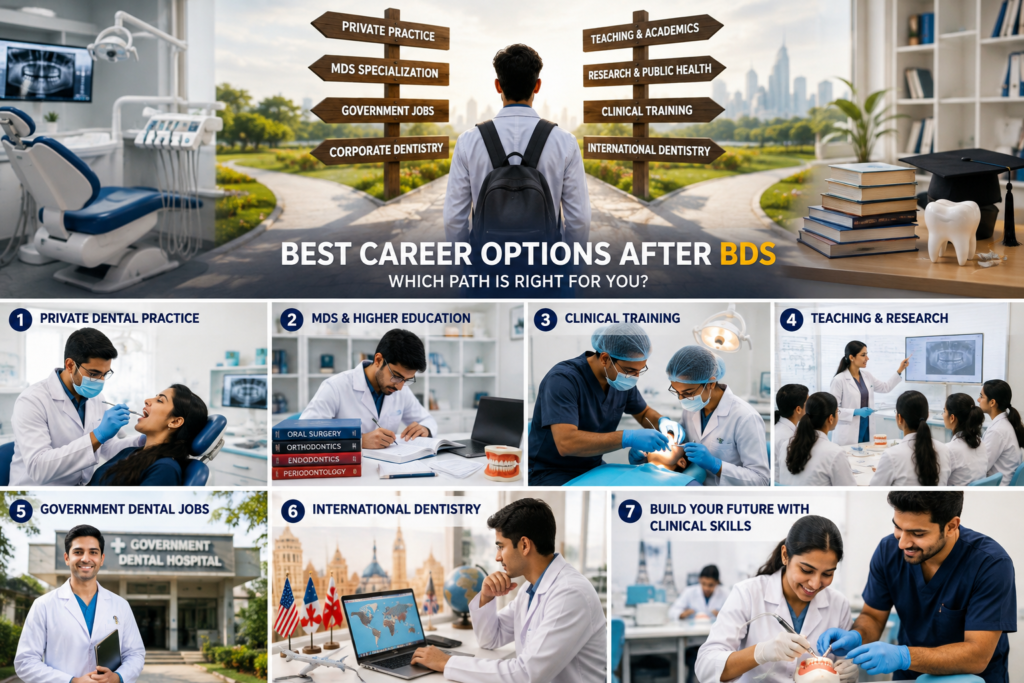
Some graduates want to start clinical practice. Others prepare for MDS, look for government opportunities, consider corporate dentistry, or explore careers in teaching, research, and international dentistry.
There is no single career path that is right for every dentist.
The best choice depends on your clinical interests, career goals, financial priorities, willingness to pursue further education, and the type of professional life you want to build. clikchere
This guide explores the major career options after BDS and explains what each path involves, who it may suit, and what you should consider before making a decision.
What Are the Best Career Options After BDS?
| Career Path | Main Focus | Suitable For |
Private Practice | Patient care and clinical experience | Dentists interested in clinical practice |
| MDS | Specialization and advanced education | Graduates interested in a specialt |
Corporate Dentistry | Structured clinical environment | Dentists seeking organizational experience |
| Government Jobs | Public healthcare | Graduates interested in government service |
| Teaching | Dental education | Those interested in academics |
“Which option best matches my career goals?”
1. Private Dental Practice
Starting work in a private dental clinic is one of the most direct ways to build clinical experience after BDS.
It gives fresh graduates an opportunity to understand how a dental practice operates, interact with different types of patients, and gradually improve their clinical decision-making.
What you can learn
- Patient examination and diagnosis
- Treatment planning
- Routine restorative procedures
- Patient communication
- Clinical documentation
- Appointment and practice workflow
For a fresh graduate, the quality of mentorship and clinical exposure can be more important than simply choosing a clinic based on its name.
Best suited for: Dentists who want to strengthen their clinical foundation and gain real-world experience.
2. MDS and Higher Education
For graduates who want to specialize, pursuing MDS can be an important career option.
MDS allows dentists to develop advanced knowledge and clinical skills in a specific area of dentistry.
Depending on your interests, specialties may include:
- Conservative Dentistry and Endodontics
- Prosthodontics
- Orthodontics
- Periodontology
- Oral and Maxillofacial Surgery
- Pediatric Dentistry
- Oral Medicine and Radiology
- Public Health Dentistry
When should you consider MDS?
MDS may be worth considering if you:
- Have a strong interest in a particular specialty
- Want advanced academic and clinical training
- Are prepared for the commitment involved in postgraduate education
- Want to pursue specialist or academic career opportunities
However, don’t choose a specialty simply because it is considered popular. Your interests, aptitude, and long-term goals should guide the decision.
3. Corporate Dental Practice
Corporate dental organizations can provide another route for fresh BDS graduates.
Working in a structured dental organization may expose you to standardized clinical processes, multidisciplinary teams, technology, and a larger patient base.
Potential advantages
- Structured work environment
- Exposure to different clinical cases
- Opportunities to learn from multiple clinicians
- Understanding of organized practice systems
- Experience with professional patient management
What should you consider?
Before joining, understand the organization’s working environment, clinical responsibilities, mentorship opportunities, compensation structure, and scope for professional development.Best suited for: Graduates who prefer a structured environment and want to gain experience before deciding on their long-term direction.
A Simple Way to Compare These Three Paths
| Option | Main Benefit | Consider If… |
| Private Practice | Clinical exposure | You want practical experience |
| MDS | Specialization | You want advanced education |
| Corporate Dentistry | Structured experience | You prefer an organized clinical environment |
Key Takeaway
Your first career decision after BDS does not have to determine your entire future.
You can gain clinical experience, pursue further education later, or change your direction as your interests become clearer. The important thing is to make the next decision intentionally rather than simply following what your peers are doing.
4. Government Dental Jobs
Government dentistry can be an attractive career path for graduates who value structured employment, public healthcare, and long-term professional stability.
Depending on the recruitment system and eligibility requirements, opportunities may be available through government hospitals, public health services, community healthcare programs, and other healthcare institutions.
Why consider government dentistry?
- Opportunity to serve a wider community
- Structured professional environment
- Exposure to public healthcare
- Potential for long-term career stability
- Experience with different patient populations
Government positions are often competitive, so graduates should regularly check official recruitment notifications and understand the eligibility requirements before applying.
Best suited for: Dentists who are interested in public healthcare and prefer a structured career environment.
5. Teaching and Academic Careers
If you enjoy explaining concepts, mentoring students, and staying connected with dental education, academics can be another career direction.
Teaching can allow dentists to combine their clinical knowledge with education and mentorship.
Depending on the position and institution, additional qualifications may be required.
A career in academics may involve:
- Teaching dental students
- Clinical demonstrations
- Academic presentations
- Student mentoring
- Continuing professional education
- Research and publications
For graduates who genuinely enjoy education, this path can offer a meaningful way to contribute to the next generation of dental professionals.
Best suited for: Dentists with an interest in teaching, mentoring, and academic development.
6. Research and Public Health
Dentistry is not limited to clinical practice.
Graduates with an interest in scientific investigation, healthcare systems, epidemiology, or community dentistry can explore research and public health-related opportunities.
Possible areas include:
- Dental research
- Oral health programs
- Epidemiological studies
- Community dentistry
- Healthcare organizations
- Academic research
This career direction may be particularly suitable for graduates who enjoy analysing problems, working with evidence, and contributing to broader improvements in oral healthcare.
7. International Career Opportunities
Some BDS graduates eventually consider working in another country.
However, an important point is often overlooked:
A BDS degree does not automatically grant permission to practise dentistry in another country.
Most countries have their own registration, licensing, examination, qualification-assessment, and language requirements.
Therefore, if international practice is your goal, research the official dental regulatory authority of the country you are targeting before making decisions about examinations or additional education.
Before planning an overseas career, consider:
- Licensing requirements
- Qualification recognition
- Required examinations
- Language requirements
- Registration procedures
- Cost and duration of the process
- Long-term career opportunities
Best suited for: Dentists who are prepared to complete the relevant licensing and registration process for their chosen country.
Quick Comparison
| Career Path | Main Advantage | Important Consideration |
| Government Dentistry | Public healthcare and structured career | Competitive recruitment |
| Teaching | Education and mentorship | Additional qualifications may be required |
| Research/Public Health | Broader healthcare impact | May require specialized education |
| International Dentistry | Overseas career opportunities | Country-specific licensing is essential |
Key Takeaway
There are many ways to build a career after BDS. Clinical practice is only one route. Government service, academics, research, public health, and international opportunities can all be considered depending on your interests and long-term goals. 8. Is Clinical Training a Good Option After BDS?
For fresh BDS graduates, one of the biggest challenges is often the transition from academic learning to confident clinical practice.
A graduate may understand the principles of a procedure but still need more experience with real clinical situations, treatment planning, patient communication, and decision-making.
This is where structured clinical training can be useful.
Clinical training can help graduates:
- Strengthen practical dental skills
- Improve clinical confidence
- Learn contemporary techniques
- Develop treatment-planning abilities
- Understand real clinical workflows
- Learn through guidance and feedback from experienced clinicians
However, not every training program offers the same learning experience.
Before choosing one, look at the curriculum, practical exposure, mentor experience, duration, learning environment, and skills covered rather than choosing a program only because it offers a certificate.
Who may benefit from clinical training?
Clinical training may be particularly useful for graduates who:
- Feel they need more practical exposure
- Want to improve specific clinical procedures
- Are preparing to enter private practice
- Want structured mentorship
- Want to strengthen their confidence before handling more complex cases
Clinical training does not replace a BDS degree or postgraduate specialization. Instead, it can complement formal dental education by providing additional opportunities for practical skill development.
How to Choose the Right Career Path After BDS
Choosing your next step becomes easier when you stop asking:
“What is everyone else doing?”
and start asking:
“What kind of dentist do I want to become?”
Consider these five questions.
1. Do I Enjoy Clinical Dentistry?
If you enjoy patient interaction and practical procedures, clinical practice or additional clinical training may be worth exploring.
2. Do I Want to Specialize?
If you have a strong interest in a particular branch of dentistry, postgraduate education may align better with your goals.
3. Do I Prefer Stability or Flexibility?
Government employment, corporate dentistry, private practice, and entrepreneurship offer different working environments and responsibilities.
Think about the type of professional lifestyle you want.
4. Do I Enjoy Teaching or Research?
If you enjoy academics, scientific investigation, or mentoring, teaching and research may provide a better fit than full-time clinical practice.
5. Where Do I Want to Work Long Term?
Your plans may be different if you want to build a practice locally, work across different cities, or eventually pursue opportunities overseas.
A Simple Career Decision Framework
| If Your Priority Is… | You Could Explore… |
| Building clinical confidence | Clinical practice + hands-on training |
| Becoming a specialist | MDS / higher education |
| Structured employment | Corporate or government dentistry |
| Teaching students | Academic dentistry |
| Scientific work | Research |
| Community healthcare | Public health |
| Working abroad | Country-specific licensing pathway |
| Owning a clinic | Clinical experience + practice development |
This isn’t a fixed formula. Your career can evolve as you gain experience and discover new interests.
One Important Reminder for Fresh Dentists
You do not need to have your entire career figured out immediately after BDS.
Your first job, training program, or postgraduate decision is an important step, but it doesn’t necessarily define your entire professional life.
Focus on building a strong foundation:
Clinical skills → Experience → Confidence → Continuous learning → Career growth
The goal should be to make informed decisions while continuing to develop as a dental professional.
Key Takeaways
- There are several legitimate career paths after BDS.
- Clinical practice is not the only option.
- Clinical training can complement your academic foundation.
- MDS may suit graduates seeking specialization.
- Government, corporate, academic, research, and international paths have different requirements.
- Choose your career based on your interests and long-term goals rather than peer pressure.
- Your career can evolve as you gain experience.
Frequently Asked Questions
1. What are the best career options after BDS?
There is no single best option for every graduate. Common paths include private clinical practice, MDS, corporate dentistry, government dentistry, teaching, research, public health, international opportunities, and structured clinical training.
2. Can I work as a dentist immediately after BDS?
Eligible graduates can pursue dental practice according to the applicable registration and regulatory requirements. However, gaining additional clinical experience can help many fresh dentists develop confidence and practical decision-making skills.
3. Is MDS necessary after BDS?
No. MDS is not the only career path after BDS. It is an option for graduates who want advanced education and specialization in a particular area of dentistry.
4. Is clinical training useful after BDS?
It can be useful for graduates who want additional practical exposure, mentorship, and opportunities to strengthen specific clinical skills.
5. Which career is best for a fresh BDS graduate?
The right career depends on your goals. A graduate interested in clinical practice may choose private practice or clinical training, while someone interested in specialization may consider MDS. Others may prefer government service, academics, research, or international opportunities.
6. Can BDS graduates work abroad?
Yes, but the requirements vary by country. Dentists generally need to meet the destination country’s licensing, registration, qualification, and other professional requirements before practising.
7. Can I change my career path after starting work?
Yes. Your first career decision does not have to determine your entire professional journey. Many dentists gain experience first and later pursue specialization, teaching, research, practice ownership, or other opportunities.
8. How can I decide which career path is right for me?
Start by evaluating your clinical interests, preferred working environment, financial and educational priorities, long-term goals, and willingness to pursue additional training or qualifications.
Final Thoughts
A BDS degree gives you a foundation, but your professional journey can take many different directions.
You may choose clinical practice, pursue MDS, work in a corporate or government setting, enter academics or research, develop additional clinical skills, or work toward an international career.
The important thing is to make the decision based on your own goals rather than comparison or pressure.
If you are a fresh graduate, you don’t need to have your entire career planned from day one. Focus on developing strong clinical fundamentals, gaining meaningful experience, finding good mentors, and continuing to learn.
Your career will become clearer as your experience grows.
The best career path is not necessarily the most popular one. It is the one that matches your skills, interests, and long-term professional goals.
Take the Next Step in Your Dental Career
If you have completed BDS and feel that you need more practical exposure before taking the next step, structured clinical skill development can be one option to consider.
Evaluate programs carefully based on their curriculum, clinical exposure, mentorship, practical learning opportunities, and relevance to your career goals.
For graduates exploring hands-on dental skill development, Kaamat Dental Academy provides structured clinical learning opportunities designed to help bridge the gap between academic knowledge and practical clinical application.
The right next step is different for every dentist. Start by identifying the skills you want to develop, then choose a learning path that supports where you want your career to go.
