
Introduction
Root canal treatment is often recommended when the soft tissue inside a tooth becomes inflamed or infected. For many patients, hearing the words “root canal” can immediately raise questions about pain, cost, treatment time, and long-term results.
But not every root canal treatment is exactly the same.
The quality of treatment can depend on several factors, including accurate diagnosis, treatment planning, cleaning and disinfection of the root canal system, proper sealing, and appropriate restoration of the tooth afterward.
This does not mean that one treatment is automatically “best” simply because it uses more equipment or costs more. A high-quality root canal is about how appropriately the case is diagnosed, planned, treated, and restored.
So, what actually separates a high-quality root canal treatment from an average or inconsistent one?
Let’s look at the important factors patients should understand.
What Is Root Canal Treatment?
Root canal treatment, commonly called a root canal, is a dental procedure used to treat a tooth when the pulp inside it becomes inflamed or infected.
The pulp contains nerves and blood vessels. Deep decay, repeated dental procedures, cracks, trauma, or other damage can sometimes affect this tissue.
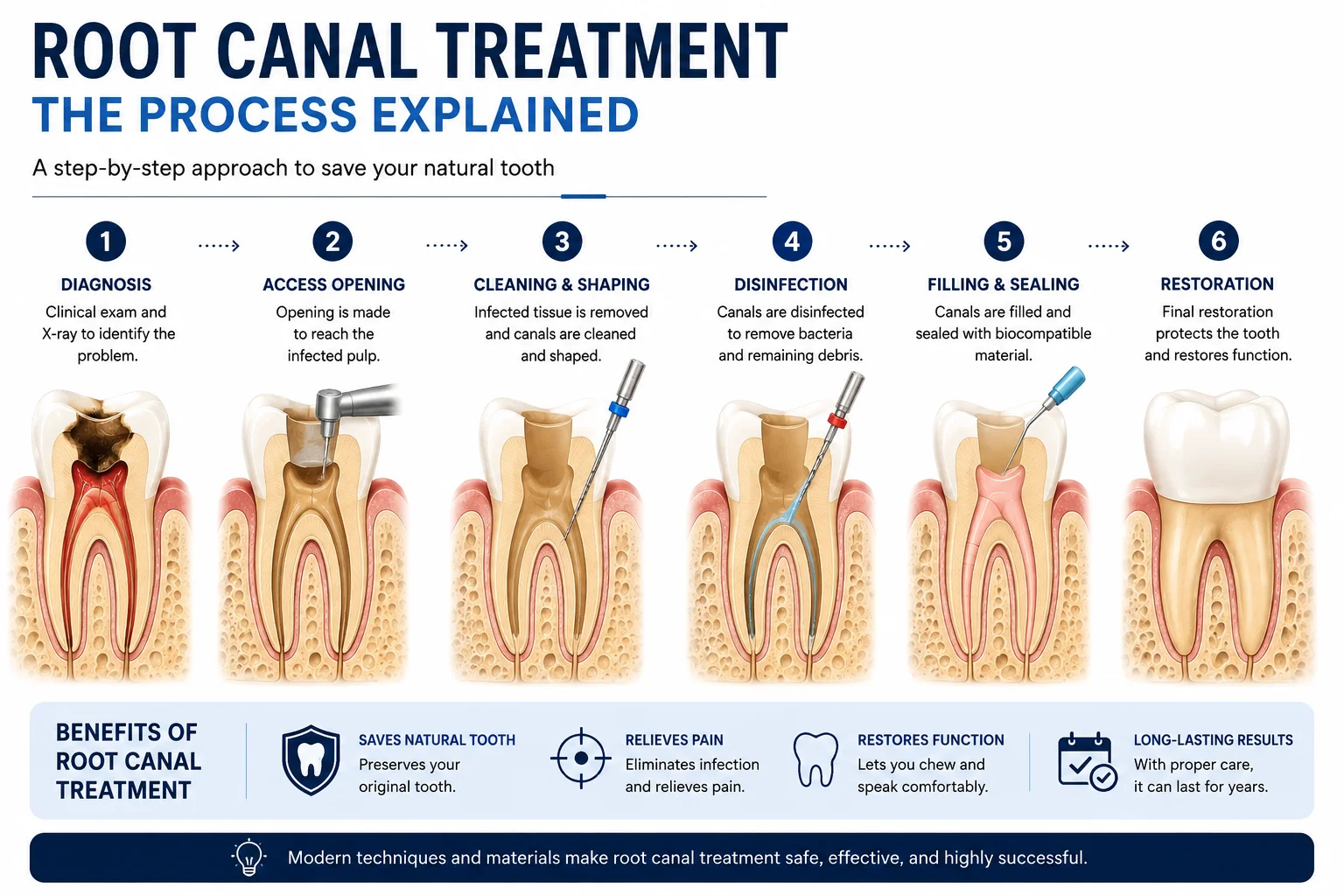
During root canal treatment, the affected tissue is removed from inside the tooth. The root canal system is then cleaned, shaped, disinfected, and filled to help prevent further infection.
The goal is not simply to remove the infected tissue.
The larger goal is to clean and seal the internal canal system while preserving the natural tooth for function.
What Makes a Root Canal Treatment High Quality?
A high-quality root canal is not defined by one particular machine, instrument, or technique.
It is usually the result of several important steps being performed carefully and appropriately for the individual case.
1. Accurate Diagnosis
Before treatment begins, the dentist needs to understand why the tooth is causing symptoms and whether root canal treatment is actually appropriate.
Pain can have different causes, and not every painful tooth necessarily requires a root canal.
A proper assessment may include:
- Dental history
- Clinical examination
- Pulp testing when appropriate
- Assessment of the surrounding tissues
- Dental imaging when required
An accurate diagnosis provides the foundation for appropriate treatment planning.
2. Proper Treatment Planning
Every tooth has its own anatomy and clinical challenges.
A molar with multiple canals may require a different approach from a simpler front tooth. Curved canals, calcification, previous treatment, cracks, and unusual anatomy can also affect treatment planning.
A good treatment plan considers:
- Tooth anatomy
- Number and configuration of canals
- Extent of infection or inflammation
- Existing restorations
- Tooth structure
- Long-term restoration requirements
The objective is to select an approach that is appropriate for the individual tooth rather than treating every case in exactly the same way.
3. Good Isolation
Keeping the treatment area isolated is an important part of root canal treatment.
A rubber dam is commonly used to isolate the tooth from saliva and the rest of the mouth during endodontic procedures.
Isolation can help create a cleaner working environment and reduce the risk of contamination during treatment.
For this reason, proper isolation is an important part of quality-focused root canal treatment.
4. Thorough Cleaning and Shaping
The root canal system can contain complex spaces and anatomical variations.
Cleaning and shaping help remove infected or affected tissue, debris, and microorganisms while preparing the canals for effective disinfection and filling.
Modern endodontic instruments, including rotary and reciprocating systems, can assist clinicians in shaping canals efficiently.
However, using advanced instruments does not automatically mean that the treatment is high quality.
The clinician’s diagnosis, technique, knowledge of anatomy, and ability to manage the individual case remain important.
5. Effective Disinfection
Mechanical cleaning alone may not be enough to address microorganisms within the root canal system.
Irrigation and appropriate disinfection protocols play an important role in reducing microbial contamination inside the canals.
This is particularly important because root canal anatomy can include areas that are difficult to reach mechanically.
The goal is to achieve effective cleaning and disinfection while protecting the surrounding tissues.
6. Proper Filling and Sealing
After the canals have been appropriately cleaned and disinfected, they need to be filled and sealed.
The purpose of root canal filling is to help prevent the space from becoming a pathway for further bacterial contamination.
A good seal is therefore an important part of successful endodontic treatment.
However, filling the canal is not the final step in restoring the tooth.
7. Appropriate Final Restoration
One of the most overlooked parts of root canal treatment is what happens after the root canal is completed.
A root-treated tooth may need an appropriate restoration to protect the remaining tooth structure and restore function.
Depending on the tooth and the amount of remaining structure, the dentist may recommend a suitable restorative option.
The final restoration should be planned as part of the overall treatment rather than treated as an unrelated step.
Key Takeaway
A high-quality root canal is not simply about “removing the infection.”
It involves a complete process:
Diagnosis → Treatment Planning → Isolation → Cleaning → Disinfection → Sealing → Final Restoration
Each stage contributes to the long-term management of the tooth.
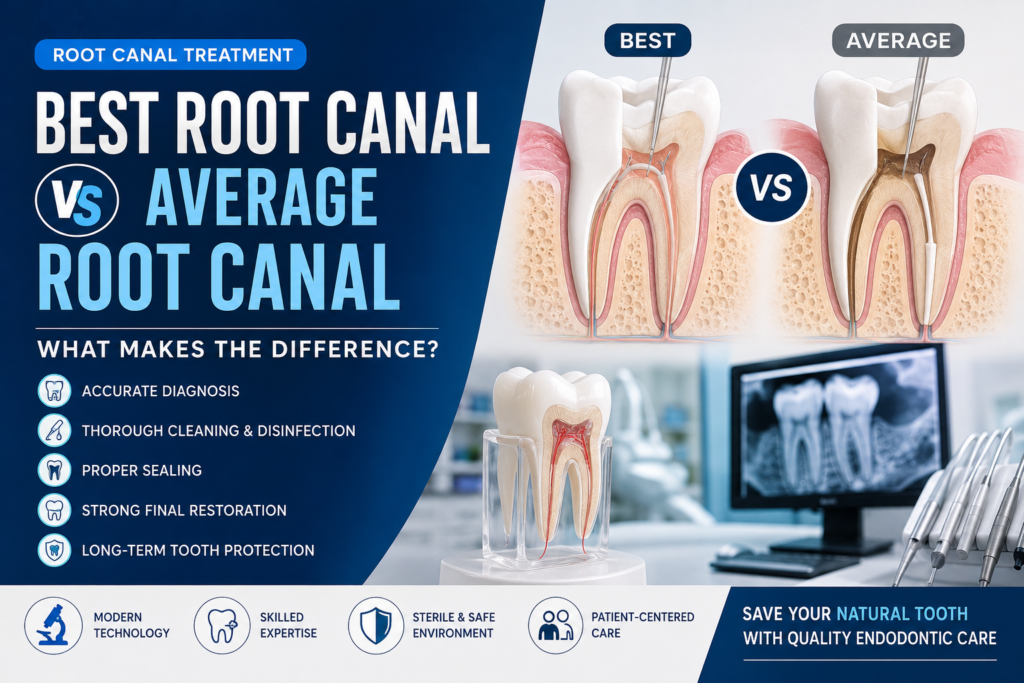
Best Root Canal vs Average Root Canal: What Is the Difference?
When patients hear the term “best root canal treatment,” they may assume it simply means the latest technology, the highest price, or a particular brand of dental equipment.
That is not necessarily true.
A quality root canal is better understood by looking at how thoroughly the case is diagnosed, planned, treated, sealed, and restored.
An “average” treatment does not automatically mean a failed treatment. However, differences in case assessment, technique, infection control, canal management, sealing, and final restoration can influence the overall quality of treatment.
Why Can Root Canal Treatment Fail?
Root canal treatment has a high potential for saving a natural tooth, but like any dental procedure, it does not guarantee success in every case.
Several factors can contribute to an unsuccessful outcome.
1. Missed Canal Anatomy
Some teeth have complex root canal systems.
If part of the canal system is not identified or adequately treated, microorganisms may remain inside the tooth and contribute to persistent infection.
This is one reason why understanding tooth anatomy and carefully assessing the canal system is important.
2. Inadequate Cleaning or Disinfection
Root canals can contain bacteria and infected tissue.
If cleaning and disinfection are inadequate, microorganisms may remain within the canal system.
Effective irrigation, appropriate instrumentation, and a carefully planned treatment protocol are therefore important components of endodontic treatment.
3. Incomplete Sealing
After cleaning and disinfection, the canals need to be appropriately filled and sealed.
An inadequate seal can allow bacterial contamination to persist or return.
This is why the quality of the final seal is an important consideration when evaluating root canal treatment.
4. Leakage From the Final Restoration
The root canal itself is only one part of saving the tooth.
If the final restoration does not adequately protect the tooth or becomes damaged, bacteria may gain access to the treated area.
This is why patients should not consider the restoration after root canal treatment as an optional or unrelated step.
5. Tooth Fracture
A root-treated tooth may have already lost significant tooth structure because of decay, cracks, previous restorations, or the treatment process itself.
If the remaining tooth structure is weak, fracture can become a concern.
The appropriate final restoration should therefore be considered according to the individual tooth.
Does Advanced Technology Make a Root Canal Better?
Technology can certainly support modern endodontic treatment.
Depending on the case, dentists may use tools such as:
- Dental operating microscopes or magnification
- Digital dental imaging
- Electronic apex locators
- Rotary or reciprocating instruments
- Advanced irrigation systems
These technologies can improve visibility, measurement, efficiency, and treatment control in appropriate cases.
However, technology alone does not determine treatment quality.
A microscope, for example, can improve visibility, but it cannot replace accurate diagnosis or clinical skill.
Similarly, advanced instruments can assist with canal preparation, but they still need to be used correctly and appropriately.
A better way to think about it:
Technology + Clinical Knowledge + Proper Technique + Case Planning = Quality-Focused Treatment
Not: Expensive Equipment = Guaranteed Success
What Should Patients Ask Be
Patients do not need to understand every technical detail of endodontics.
But asking a few simple questions can help them understand their treatment better.
Consider asking:
1. Why does this tooth need a root canal?
Understanding the diagnosis helps you know why the treatment has been recommended.
2. What does the treatment involve?
Your dentist can explain the expected steps based on your particular tooth.
3. Does the tooth have any complex anatomy?
Some teeth can have curved or multiple canals that may affect treatment planning.
4. What restoration will the tooth need afterward?
This is particularly important because the long-term protection of the treated tooth matters.
5. Will I need a follow-up appointment?
Your dentist can advise whether follow-up is appropriate for your case.
Key Takeaway
When comparing a high-quality root canal with an average or inconsistent approach, don’t focus only on the price or equipment.
Look at the complete treatment process:
Accurate diagnosis → Careful planning → Proper isolation → Thorough cleaning → Effective disinfection → Good sealing → Appropriate final restoration
That complete approach is what matters most.
Does a More Expensive Root Canal Mean Better Treatment?
Not necessarily.
The cost of root canal treatment can vary depending on factors such as the tooth involved, complexity of the case, diagnostic requirements, treatment approach, materials, technology used, and the restoration needed afterward.
However, price alone should not be used as a measure of treatment quality.
A higher treatment fee does not automatically guarantee a better outcome, just as a lower fee does not automatically mean poor treatment.
Instead, patients should look at the overall approach to their care.
Consider these factors:
- Is the diagnosis clearly explained?
- Is the treatment plan appropriate for the tooth?
- Is the treatment area properly isolated?
- Are the canals carefully cleaned and disinfected?
- Is the canal system adequately sealed?
- Is the final restoration planned?
- Does the dentist explain what to expect after treatment?
These factors are more meaningful indicators of a quality-focused approach than price alone.
What Happens After Root Canal Treatment?
Completing the root canal procedure does not necessarily mean the entire treatment journey is finished.
The tooth may require a permanent restoration to restore its function and protect the remaining tooth structure.
The type of restoration depends on several factors, including:
- Which tooth has been treated
- How much natural tooth structure remains
- The amount of biting force the tooth receives
- The condition of existing restorations
- The dentist’s assessment of the tooth
For some teeth, a crown or another suitable restoration may be recommended.
Why is the final restoration important?
A root-treated tooth can be vulnerable to fracture, particularly when substantial tooth structure has already been lost.
A properly planned restoration can help protect the tooth and allow it to function normally.
This is why patients should think of root canal treatment as a complete treatment process, rather than only the procedure performed inside the roots.
How Long Does a Root Canal Take?
There is no single treatment time that applies to every tooth.
A straightforward case may be completed in fewer appointments, while a complex tooth may require additional time or appointments.
Factors that can influence treatment duration include:
- Number of canals
- Canal anatomy
- Severity of infection
- Presence of previous root canal treatment
- Difficulty of accessing the canals
- Need for additional procedures
- Overall condition of the tooth
Therefore, it is better to ask your dentist about the expected treatment plan rather than comparing your treatment time with someone else’s.
When Should You Consider a Second Opinion?
A second opinion can be useful when you are uncertain about a diagnosis or treatment recommendation.
For example, you may consider seeking another professional opinion if:
- You have been given different treatment recommendations
- The tooth has unusual or complex anatomy
- A previous root canal has not resolved the problem
- You have persistent symptoms after treatment
- You are unsure about whether the tooth can be saved
- You are considering extraction versus saving the natural tooth
A second opinion is not about questioning the dentist personally.
It is about helping you understand the available treatment options and make an informed decisio
Can a Previously Treated Tooth Need Another Root Canal?
Yes.
A tooth that has already undergone root canal treatment can sometimes develop persistent or recurrent problems.
This may happen for different reasons, including:
- Complex anatomy that was not adequately treated
- Persistent infection
- New contamination
- Leakage around the restoration
- A crack or fracture
- Other problems affecting the tooth or surrounding tissues
Depending on the cause, treatment options may include non-surgical retreatment, surgical endodontic treatment, restoration, or extraction.
The appropriate option depends on the individual case and should be determined after proper clinical assessment.
What Does “Best Root Canal” Really Mean?
The phrase “best root canal” can be misleading if it is interpreted as a specific machine, technique, or expensive treatment.
There is no single procedure that is automatically the best for every tooth.
A better definition is:
A quality root canal is one that is appropriately diagnosed, carefully planned, competently performed, properly sealed, and followed by suitable restoration and care.
The treatment should be based on the patient’s tooth, anatomy, diagnosis, and clinical needs.
That is much more useful than simply asking:
“Which root canal is the best?”
A better question is:
“What treatment approach is appropriate for my tooth, and how will the tooth be protected afterward?”
How Can Patients Identify a Quality Root Canal Treatment?
Patients do not need to understand every technical detail of endodontic treatment to make an informed decision.
Instead, focus on whether your dentist clearly explains the diagnosis, treatment plan, expected outcome, and restoration required after the procedure.
Before starting treatment, you can ask:
1. What is the actual problem with my tooth?
Ask whether the symptoms are related to pulp inflammation, infection, a crack, or another dental condition.
Understanding the diagnosis helps you understand why root canal treatment has been recommended.
2. Does my tooth have complex canal anatomy?
Some teeth can have multiple, narrow, curved, or difficult-to-locate canals. Knowing whether your tooth presents additional challenges can help you understand the treatment plan.
3. What will happen during the root canal?
Your dentist should be able to explain the major stages of treatment in terms you can understand.
4. What restoration will I need afterward?
Don’t consider the root canal as the final step. Ask how the tooth will be restored and protected after the internal treatment is completed.
5. What should I expect after treatment?
Your dentist can explain normal post-treatment symptoms, care instructions, and when you should return for review.
When Should You Not Delay Root Canal Treatment?
A tooth that needs root canal treatment may not always cause severe pain.
Some teeth can have significant infection with relatively mild symptoms, while others may cause noticeable pain or sensitivity.
Seek a dental evaluation if you experience symptoms such as:
- Persistent toothache
- Sensitivity to hot or cold that lingers
- Pain while biting or chewing
- Swelling around the tooth
- A recurring dental abscess
- Discoloration of a tooth
- A damaged or cracked tooth
These symptoms do not automatically mean you need a root canal. A proper examination is needed to determine the cause.
Early evaluation can help your dentist identify the problem and discuss appropriate treatment options.
What Should You Look for When Choosing a Root Canal Provider?
Instead of choosing a clinic only because it advertises a “best” or “premium” root canal, consider the overall quality of care.
Look for:
Clear Diagnosis
The dentist should explain what is happening with your tooth and why treatment is recommended.
Appropriate Treatment Planning
The treatment should be based on your individual tooth and clinical condition.
Good Clinical Practices
Proper isolation, cleaning, disinfection, and sealing are important parts of root canal treatment.
Appropriate Technology
Technology can support diagnosis and treatment when it is clinically appropriate.
Restoration Planning
The tooth should be assessed for the appropriate restoration after root canal treatment.
FAQ’s
Is the most expensive root canal always the best?
No. Cost alone does not determine treatment quality. The diagnosis, treatment approach, clinical technique, sealing, restoration, and overall case management are more important considerations.
What makes a root canal high quality?
A quality root canal involves appropriate diagnosis and planning, careful cleaning and disinfection of the canal system, proper sealing, and suitable restoration of the tooth.
Does every root canal require a crown?
Not necessarily. The need for a crown or another restoration depends on the tooth, the amount of remaining structure, functional demands, and the dentist’s assessment.
Can a root canal fail?
Yes. Root canal treatment can sometimes fail or develop problems later. Causes can include untreated canal anatomy, persistent infection, leakage, fracture, or other clinical factors.
Is root canal treatment painful?
Modern dental techniques and local anesthesia are used to make treatment comfortable for most patients. Some soreness or sensitivity can occur after treatment and should generally be discussed with your dentist if it persists or becomes significant.
How long does a root canal take?
Treatment time varies depending on the tooth, canal anatomy, infection, previous treatment, and complexity of the case. Some treatments may require one appointment, while others may need more.
Can a previously treated tooth be treated again?
In some cases, yes. Retreatment or other procedures may be considered depending on why the previous treatment was unsuccessful and whether the tooth can be predictably restored.
Should I get a second opinion before a root canal?
A second opinion can be useful when the diagnosis is unclear, treatment options differ, the case is complex, or you are deciding between saving the tooth and extraction.
Final Thoughts
A best root canal treatment should not be defined simply by price, technology, or the number of appointments.
What matters is the quality of the complete treatment process.
From accurate diagnosis and careful treatment planning to cleaning, disinfection, sealing, and final restoration, every stage contributes to the long-term management of the tooth.
If you have been advised to undergo root canal treatment, take the time to understand why you need it, what the treatment involves, how the tooth will be restored, and what you can expect afterward.
An informed patient can have a much clearer conversation with their dentist and make decisions based on their individual dental needs.
Take the Next Step
If you have persistent tooth pain, sensitivity, swelling, or other symptoms that may indicate a dental infection, don’t rely on online information alone.
A professional dental examination is the right way to determine the cause and appropriate treatment.
For dental professionals looking to strengthen their practical understanding of endodontic procedures, structured clinical skill development and hands-on training can provide additional opportunities to learn treatment principles under appropriate guidance.
