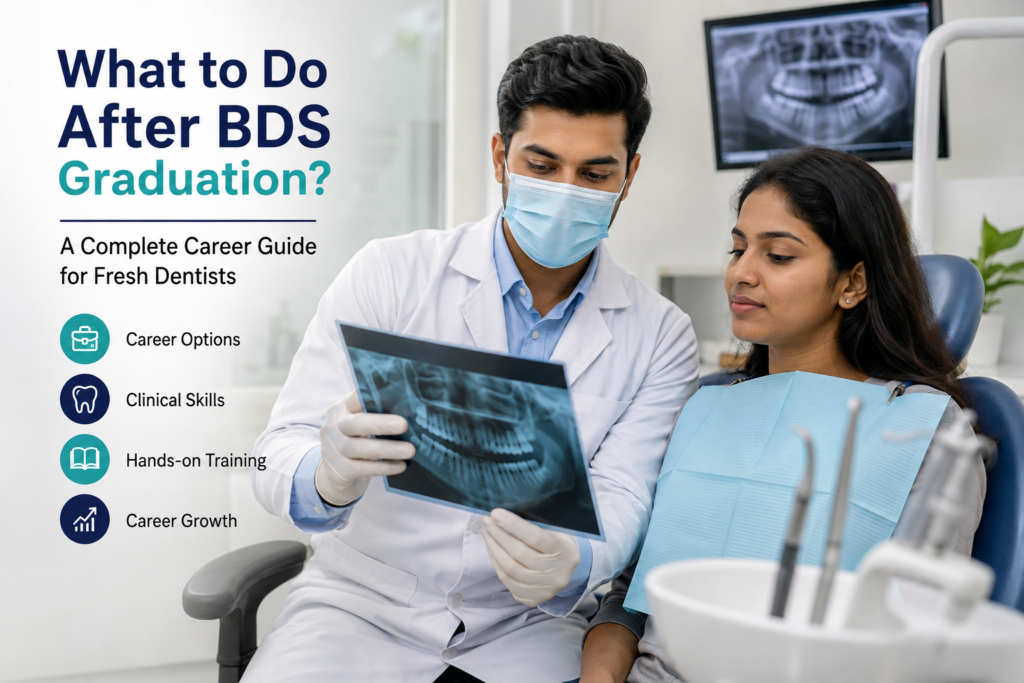
Why Do Many Fresh Dentists Lack Clinical Confidence?
Many fresh dentists feel less confident because they have limited exposure to independent patient management and real-world clinical decision-making during their undergraduate education.
Graduating from dental school provides a strong theoretical foundation, but the transition to independent clinical practice often presents new challenges. Many fresh dentists experience uncertainty when they begin treating patients without close supervision.
This lack of confidence does not necessarily indicate a lack of knowledge. Instead, it reflects the need for greater practical exposure and repeated clinical experience. Skills such as diagnosis, treatment planning, patient communication, time management, and handling unexpected situations improve with guided practice over time.
Some of the most common reasons include:
Limited Hands-on Experience
Fear of Making Mistakes
Treating real patients carries responsibility. It is natural for fresh graduates to worry about making clinical errors or managing unexpected complications.
Limited Exposure to Modern Clinical Techniques
Dental technology continues to evolve. Techniques such as rotary endodontics, rubber dam isolation, digital dentistry, and advanced restorative procedures may require additional training beyond undergraduate education.
Communication Challenges
Explaining treatment plans, discussing costs, addressing patient concerns, and building trust are essential professional skills that develop with practice.
Lack of Clinical Mentorship
Working under experienced mentors helps graduates refine their clinical decision-making, improve procedural skills, and build professional confidence in a supportive environment.
The encouraging news is that clinical confidence is not an inborn talent it develops through consistent learning, supervised practice, constructive feedback, and a commitment to continuous improvement.
What Are the Best Career Options After BDS Graduation?
After BDS graduation, there is no single “best” career path. The right option depends on your interests, clinical confidence, long-term goals, and willingness to continue learning. Some graduates choose higher studies, while others focus on clinical practice, government jobs, teaching, research, or opportunities abroad.
The most important decision is not how quickly you start, but how well you prepare for the career you want to build.
Why Choosing the Right Career Path Matters
Many fresh BDS graduates feel pressured to make an immediate career decision. Friends may be preparing for MDS entrance exams, some may join private clinics, while others start searching for jobs. This often creates confusion and unnecessary stress.
Instead of following what everyone else is doing, take time to evaluate:
- What kind of dentist do you want to become?
- Do you enjoy treating patients every day?
- Are you interested in specialization?
- Do you want to own a clinic in the future?
- Are you planning to work in India or abroad?
1. Join a Private Dental Clinic
Working in a private dental clinic is one of the most common choices after BDS. It allows graduates to observe experienced dentists, interact with patients, and gradually improve their clinical confidence.
Advantages
- Daily patient exposure
- Learn clinical workflow
- Improve communication skills
- Understand treatment planning
- Gain practical experience
Challenges
- Limited opportunities to perform complex procedures in some clinics
- Initial salary may be modest
- Learning depends on mentorship and patient flow
Who is this suitable for?
Graduates who want to build confidence before planning higher studies or starting independent practice.
2. Join a Hands-on Clinical Training Program
For many graduates, structured clinical training helps bridge the gap between theoretical learning and practical dentistry.
These programs often focus on supervised clinical procedures, treatment planning, modern dental techniques, and real-world case discussions.
Benefits
- Improve procedural confidence
- Learn contemporary clinical techniques
- Receive guidance from experienced mentors
- Practice in a structured environment
- Develop decision-making skills
Expert Insight
Clinical confidence grows through repeated practice under proper guidance. A well-designed training program can complement the knowledge gained during BDS and help graduates transition more comfortably into clinical practice.
3. Prepare for MDS
Many students choose Master of Dental Surgery (MDS) to specialize in a specific branch of dentistry.
Popular specialties include:
- Conservative Dentistry & Endodontics
- Orthodontics
- Prosthodontics
- Periodontics
- Oral Surgery
- endodontic
- Oral Medicine
- Public Health Dentistry
Advantages
- Specialization
- Advanced knowledge
- Better long-term career opportunities
- Academic and teaching options
Consider Before Choosing
Pursuing MDS requires commitment, preparation, and a genuine interest in a specialty. It should be a career decision rather than something chosen only because others are doing it.
4. Work in Corporate Dental Chains
Corporate dental hospitals offer graduates exposure to standardized systems, multidisciplinary teams, and modern dental technologies.
Advantages
- Professional work environment
- Team-based learning
- Better exposure to advanced equipment
- Consistent patient flow
Challenges
- Performance expectations
- Structured work schedules
- Limited flexibility compared with independent practice
5. Government Sector Opportunities
Some graduates prepare for opportunities in:
- Government hospitals
- Community health centers
- Public health programs
- Defence services
- Railway health services
- State recruitment examinations
6. Academic and Teaching Career
If you enjoy teaching and mentoring students, academics can be a rewarding career path.
Many professionals combine teaching with clinical practice, allowing them to contribute to both education and patient care.
7. Research and Public Health
Dentistry also offers opportunities outside traditional clinical practice.
Graduates interested in research, epidemiology, public health, healthcare policy, or dental product development may find fulfilling careers in these fields.
8. International Career Opportunities
Some dentists plan to practice abroad.
Countries such as the United Kingdom, Australia, Canada, New Zealand, and the Gulf region have different licensing pathways and eligibility requirements.
Before making this decision, research the licensing process, examinations, language requirements, and registration guidelines for the country where you intend to practice
Career Options After BDS – Quick Comparison
Career Path | Main Focus | Best For |
Private Dental Clinic | Practical experience | Fresh graduates seeking clinical confidence |
Clinical Training Program MDS | Hands-on skill development Specialization | Graduates wanting structured clinical learning |
Corporate Dental Chain | Professional clinical exposure | Students interested in advanced education |
Government Sector | Public healthcare | Graduates seeking organized work environments |
Research & Public Health | Scientific and community health | Graduates interested in research and policy |
Teaching | Dental education | Those interested in academics |
International Career | Global opportunities | Dentists planning to practice overseas |
Table of Contents
- What Should You Do Immediately After BDS Graduation?
- Why Do Many Fresh Dentists Lack Clinical Confidence?
- What Career Options Are Available After BDS?
- Is Hands-on Clinical Training Important?
- Skills Every BDS Graduate Should Develop
- How to Choose the Right Clinical Training Program
- Common Mistakes to Avoid After BDS
- Frequently Asked Questions
- Final Thoughts
What Should You Do Immediately After BDS Graduation?
Graduating with a BDS degree is an important achievement, but it is only the beginning of your professional journey. The transition from being a student to becoming a confident dental professional requires careful planning, continuous learning, and real clinical exposure.
After completing BDS, focus on strengthening your clinical skills, identifying your career goals, gaining practical experience, and creating a clear professional development plan instead of rushing into major decisions.
Many graduates feel uncertain because there are several career paths to choose from. Some prepare for postgraduate entrance examinations, while others join private clinics, corporate dental hospitals, or clinical training programs. Instead of comparing your journey with others, take time to evaluate your strengths, interests, and long-term goals.
A practical approach after BDS includes:
- Assessing your current clinical strengths and areas that need improvement.
- Practising fundamental procedures under expert supervision.
- Learning modern dental techniques and technologies.
- Improving communication and patient management skills.
- Building confidence through consistent hands-on experience.
- Exploring career opportunities that match your professional aspirations.
Remember, confidence is built through experience, not by obtaining a degree alone. The more practical exposure you gain during the early stages of your career, the better prepared you will be to handle real patients and clinical challenges.
Why Is Hands-on Clinical Training Important After BDS?
Hands-on clinical training helps bridge the gap between academic learning and real-world dental practice. It allows fresh BDS graduates to improve their practical skills, clinical decision-making, patient communication, and confidence under expert guidance.
Completing BDS gives you a strong academic foundation, but becoming a confident dentist requires much more than theoretical knowledge. Every patient is different, and every clinical situation presents unique challenges.
Many fresh graduates realise that performing a procedure independently feels very different from observing it during dental school. This is where structured clinical training becomes valuable.
Hands-on learning allows you to apply what you already know in real clinical situations while receiving feedback from experienced mentors. Over time, this repeated practice helps reduce hesitation and improve confidence.
Think of it this way:
What Makes Clinical Training Different from Classroom Learning?
During undergraduate education, students spend years studying anatomy, pathology, pharmacology, diagnosis, treatment planning, and clinical procedures. This knowledge is essential and forms the foundation of every dental career.
However, real clinical practice requires additional skills that develop through experience.
For example, a dentist must be able to:
- Communicate clearly with patients.
- Explain treatment options in simple language.
- Manage anxious patients.
- Make clinical decisions based on individual cases.
- Handle unexpected situations during procedures.
- Maintain infection control standards.
- Work efficiently while ensuring patient comfort.
These are practical abilities that improve with guided clinical exposure rather than textbooks alone.
Common Challenges Faced by Fresh BDS Graduates
Many graduates experience similar concerns during the early stages of their careers.
Some common challenges include:
Lack of Clinical Confidence
Knowing the theory is different from performing procedures independently.
Fear of Making Mistakes
It is natural to feel nervous while treating your first few patients. Confidence develops gradually through supervised practice.
Limited Exposure to Advanced Techniques
Modern dentistry continues to evolve with technologies such as rotary endodontics, rubber dam isolation, digital workflows, and adhesive restorative techniques.
Learning these methods can help graduates stay aligned with current clinical practice.
Difficulty in Treatment Planning
Successful dentistry is not just about performing procedures. It also involves selecting the most appropriate treatment for each patient’s needs.
Communication Skills
Patients often have questions, concerns, and expectations.
Explaining treatment plans clearly and building trust are important parts of professional dental practice.
Benefits of Hands-on Clinical Training
A structured training program can help graduates strengthen both technical and professional skills.
Some important benefits include:
Improved Clinical Confidence
Repeated practice under supervision helps reduce hesitation and improves decision-making.
Better Practical Skills
Graduates gain opportunities to perform procedures using systematic clinical protocols.
Exposure to Modern Dentistry
Training programs often introduce contemporary techniques and updated clinical workflows.
Learning from Experienced Mentors
Constructive feedback from experienced clinicians helps identify mistakes early and encourages continuous improvement.
Professional Development
Clinical competence, communication, ethical practice, and patient management all contribute to long-term career growth.
Essential Skills Every BDS Graduate Should Develop
Regardless of your career path, certain clinical and professional skills remain valuable throughout your dental journey.
1. Diagnosis and Treatment Planning
Before performing any procedure, a dentist must accurately evaluate the patient’s condition and select an appropriate treatment plan.
Strong diagnostic skills improve clinical outcomes and patient trust.
2. Endodontic Skills
Understanding modern root canal procedures, case selection, access preparation, cleaning, shaping, and obturation can significantly improve clinical efficiency.
3. Rubber Dam Isolation
Proper isolation improves visibility, moisture control, patient safety, and treatment quality during many restorative and endodontic procedures.
4. Composite Restorations
Knowledge of shade selection, cavity preparation, bonding protocols, layering techniques, and finishing procedures contributes to predictable restorative outcomes.
5. Infection Control
Following standard infection prevention protocols protects both patients and dental professionals.
Maintaining a safe clinical environment should always remain a priority.
6. Patient Communication
Technical skills alone are not enough.
A successful dentist should also know how to:
- Listen carefully
- Explain treatment clearly
- Address patient concerns
- Build trust
- Maintain professionalism
Good communication often improves patient satisfaction as much as good clinical work.
7. Time Management
Managing appointments efficiently helps reduce stress, improve workflow, and provide a better patient experience.
8. Continuous Learning
Dentistry evolves every year.
Reading journals, attending workshops, participating in continuing education programs, and staying updated with new technologies support long-term professional growth.
Expert Insight
Many experienced dentists agree on one important principle:
Clinical confidence is developed through consistent practice, thoughtful reflection, and a willingness to learn from every patient encounter.
There is no shortcut.
The dentists who continue learning throughout their careers are often better prepared to adapt to new techniques, technologies, and patient expectations.
Key Takeaways
✔ Practical experience complements theoretical knowledge.
✔ Clinical confidence develops gradually with supervised practice.
✔ Modern dentistry requires continuous learning.
✔ Communication and treatment planning are as important as technical skills.
✔ Investing in skill development early in your career can contribute to long-term professional growth.
How to Choose the Right Clinical Training Program After BDS?
Choosing the right clinical training program is about more than earning a certificate. A good program should help you build practical skills, improve clinical confidence, provide mentorship, and prepare you for real patient care.
After completing BDS, many graduates begin looking for additional training to improve their practical knowledge. However, not every training program offers the same learning experience.
Some programs focus mainly on classroom lectures, while others provide structured hands-on clinical exposure. Before making a decision, it is important to understand what you want to achieve from the program.
Ask yourself:
- Do I want to improve my clinical confidence?
- Do I need more practical exposure?
- Which clinical procedures do I want to master?
- Am I preparing for private practice or higher studies?
- Will this program help me become a better clinician?
What Should You Look for in a Clinical Training Program?
Instead of selecting a course based only on popularity or marketing, evaluate the quality of the learning experience.
1. Practical Hands-on Learning
The primary purpose of clinical training is to improve practical skills.
Look for programs that provide opportunities to observe, assist, and perform procedures under proper supervision whenever appropriate.
2. Experienced Mentors
Learning from experienced clinicians can help you understand not only how to perform procedures but also why specific clinical decisions are made.
Mentorship often plays an important role in professional growth.
3. Updated Clinical Techniques
Dentistry continues to evolve with new materials, technologies, and treatment protocols.
A good training program should introduce learners to modern clinical concepts while emphasizing evidence-based dentistry.
4. Small Batch Learning
Smaller groups generally provide more opportunities for interaction, discussion, and individual guidance.
This can improve both learning quality and confidence.
5. Real Clinical Exposure
Observing and participating in real clinical workflows helps graduates understand patient management, diagnosis, treatment planning, documentation, and professional communication.
6. Structured Curriculum
A well-organized curriculum ensures that learning progresses from basic concepts to more advanced procedures in a logical sequence.
Checklist Before Joining a Clinical Training Program
Before enrolling, ask these questions:
✔ Does the curriculum cover practical clinical procedures?
✔ Who are the mentors and what is their clinical experience?
✔ What is the duration of the training?
✔ Is there enough opportunity for supervised learning?
✔ Are modern clinical techniques included?
✔ What skills will I develop after completing the program?
✔ Does the training support long-term professional development?
Common Mistakes Every Fresh Dentist Should Avoid
The first few years after BDS are an important learning phase. Avoiding common mistakes can help you build confidence and establish a strong professional foundation.
1. Rushing Into Independent Practice
Starting independent practice without adequate clinical confidence can be challenging.
Develop your practical skills gradually before taking on more complex cases.
2. Ignoring Practical Skill Development
Theoretical knowledge is valuable, but continuous clinical learning is equally important.
Make practical training a regular part of your professional development.
3. Comparing Your Journey With Others
Every dentist progresses at a different pace.
Focus on your own learning rather than comparing yourself with classmates or colleagues.
4. Stopping Learning After Graduation
Graduation is not the end of learning.
Attend workshops, read scientific literature, and stay updated with advances in dentistry.
5. Underestimating Communication Skills
Successful dentistry is built on both clinical competence and patient trust.
Develop the ability to explain treatment plans clearly and communicate with empathy.
6. Focusing Only on Income
During the early stages of your career, gaining knowledge, experience, and confidence is often more valuable than chasing higher earnings.
Professional growth usually leads to better long-term opportunities.
7. Avoiding Difficult Cases Completely
While beginners should work within their competence, observing and discussing challenging cases with mentors can accelerate learning.
Every case is an opportunity to improve your clinical reasoning.
8. Neglecting Documentation
Maintaining accurate patient records, radiographs, treatment notes, and informed consent is an essential part of ethical dental practice.
Good documentation supports continuity of care and professional accountability.
9. Ignoring Infection Control Standards
Patient safety should never be compromised.
Following proper sterilization and infection control protocols is a professional responsibility.
10. Losing Confidence After Early Challenges
Every experienced dentist has faced difficult cases and setbacks.
Treat each experience as a learning opportunity rather than a failure.
Consistent practice, reflection, and mentorship gradually build confidence.
Expert Tip
One of the biggest differences between an average dentist and an excellent dentist is not intelligence it is the commitment to continuous improvement.
The dentists who regularly learn, practise, seek feedback, and refine their skills are often better prepared to provide high-quality patient care throughout their careers.
Practical Action Plan After BDS
If you are unsure where to begin, this roadmap may help:
Month 1
- Assess your current clinical skills.
- Identify areas for improvement.
- Set short-term career goals.
Month 2
- Gain supervised clinical exposure.
- Improve patient communication.
- Learn modern clinical techniques.
Month 3
- Build confidence with routine procedures.
- Develop treatment planning skills.
- Continue learning through workshops and professional education.
Small, consistent steps often lead to significant professional growth over time.
Key Takeaways
✔ Choose learning opportunities based on quality, not popularity.
✔ Practical experience is essential for building clinical confidence.
✔ A good mentor can accelerate your professional development.
✔ Avoid comparing your progress with others.
✔ Continuous learning is one of the most valuable investments in your dental career.
Frequently Asked Questions
1. What should I do immediately after BDS graduation?
After BDS graduation, take time to evaluate your career goals, improve your clinical skills, gain practical experience, and create a clear learning plan. Avoid making rushed career decisions based only on what others are doing.
2. Can I start my own dental practice immediately after BDS?
Legally, eligible BDS graduates may be able to practice according to applicable regulations. However, many fresh dentists benefit from gaining additional supervised clinical experience before managing patients independently. Practical exposure often helps build confidence and clinical judgment.
3. Is hands-on clinical training necessary after BDS?
Hands-on clinical training is not mandatory for every graduate, but many dentists find it valuable for improving practical skills, clinical confidence, treatment planning, and patient management before moving into independent practice.
4. Should I choose MDS or clinical practice after BDS?
There is no single right answer.
If you want to specialize in a particular branch of dentistry, MDS may be the right choice. If your goal is to improve practical clinical skills first, gaining supervised clinical experience can also be beneficial.
The decision should depend on your long-term career goals.
5. Which clinical skills should every fresh dentist develop?
Important skills include:
- Diagnosis
- Treatment planning
- Endodontics
- Restorative dentistry
- Infection control
- Patient communication
- Clinical documentation
- Time management
Developing these skills gradually can improve both confidence and patient care.
6. Why do many fresh dentists feel less confident?
Many graduates have a strong theoretical foundation but limited exposure to independent patient management.
Confidence usually develops through repeated clinical experience, mentorship, and continuous learning.
7. How long does it take to become clinically confident?
There is no fixed timeline.
Confidence develops at different speeds for different individuals depending on clinical exposure, practice opportunities, learning attitude, and mentorship.
Consistency is more important than speed.
8. Is communication important for dentists?
Yes.
Good communication helps patients understand treatment options, builds trust, improves patient satisfaction, and supports better clinical outcomes.
Technical skills and communication skills should develop together.
9. Should I continue learning after completing BDS?
Absolutely.
Dentistry continues to evolve through new materials, technologies, and treatment protocols.
Reading journals, attending workshops, participating in continuing education, and learning from experienced clinicians support long-term professional growth.
10. How can I build a successful career after BDS?
A successful dental career is usually built on:
- Strong clinical skills
- Ethical practice
- Continuous learning
- Good communication
- Professionalism
- Patient-centred care
- Long-term commitment to improvement
Success rarely happens overnight. It develops through consistent effort over time.
Final Thoughts
Completing BDS is an important milestone, but it is only the beginning of your professional journey.
The transition from dental school to independent clinical practice takes time, patience, and continuous learning. Every experienced dentist was once a beginner who gradually developed confidence through practice and experience.
Rather than feeling pressured to have all the answers immediately after graduation, focus on building a strong foundation. Strengthen your clinical skills, seek guidance from experienced mentors, stay updated with modern dentistry, and commit to lifelong learning.
Whether your goal is higher education, clinical practice, public service, teaching, research, or international opportunities, your early career decisions should be guided by knowledge, preparation, and professional growth rather than haste.
Remember that becoming a successful dentist is not about learning everything at once. It is about improving a little every day, treating every patient responsibly, and continuously striving to become a better clinician.
The investments you make in your knowledge, practical skills, and professional development today can shape your dental career for many years to come.
About Kaamat Dental Academy
For graduates who are looking to strengthen their clinical skills through structured learning, exploring a hands-on training program can be a valuable step in professional development.
At Kaamat Dental Academy, the focus is on helping fresh dentists bridge the gap between classroom learning and clinical practice through guided mentorship, practical exposure, and skill-oriented training. Prospective learners are encouraged to review the curriculum, faculty, and learning outcomes to determine whether the program aligns with their individual career goals.
Ready to Take the Next Step?
If your goal is to become a more confident clinician, start by identifying the skills you want to improve and create a learning plan that supports your long-term career.
The first few years after BDS offer valuable opportunities to build knowledge, confidence, and professional experience. Choosing quality learning experiences during this period can have a lasting impact on your growth as a dentist.
